




EN 1317 Road Restraint Systems
The European performance-based standard for inspecting and classifying road safety barriers, crash cushions, and terminals.
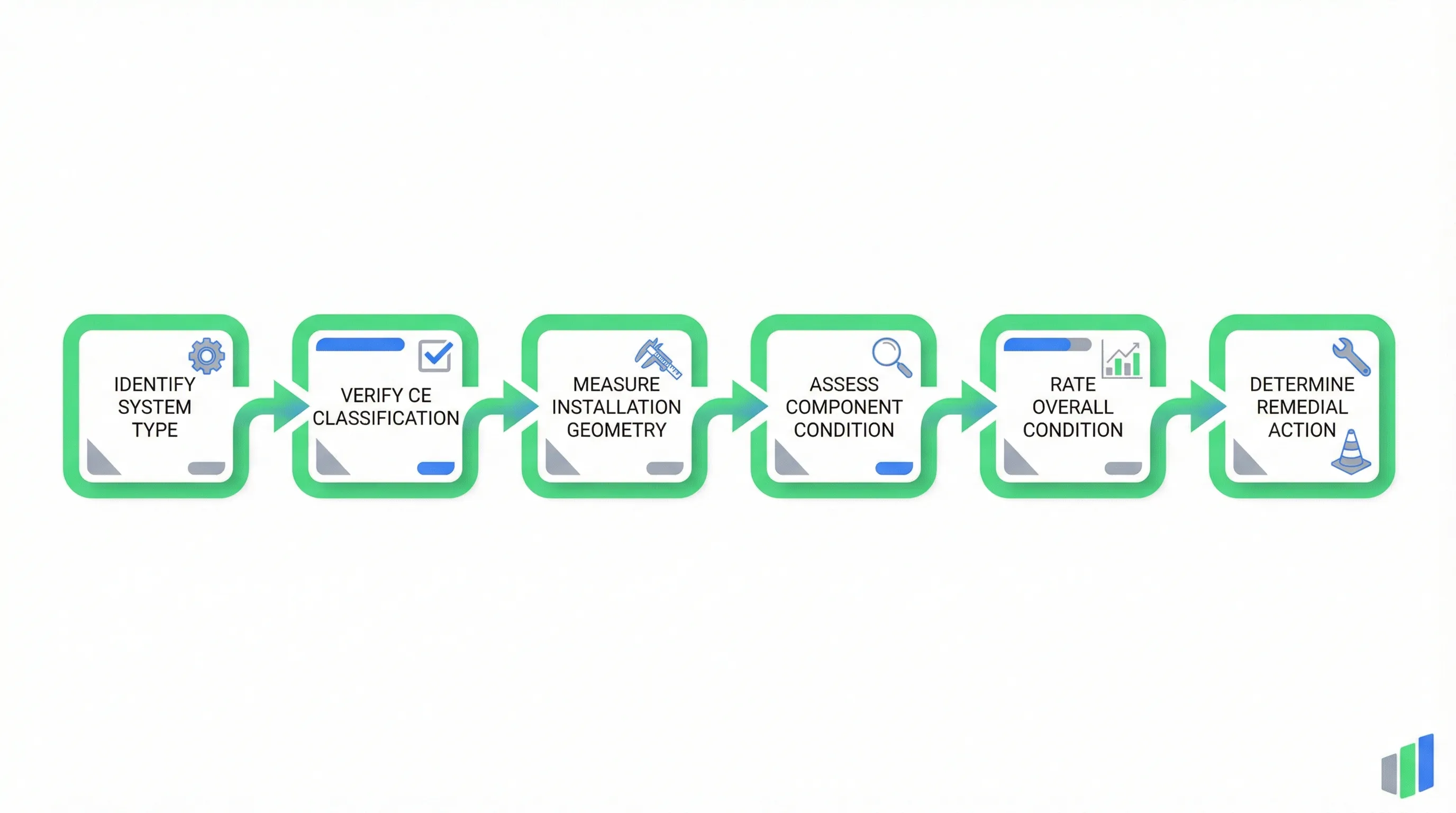
EN 1317 is the harmonized European standard governing road restraint systems. Unlike prescriptive design standards, EN 1317 classifies barriers by their performance in full-scale crash tests, defining containment levels from T1 (low-angle redirect) through L4b (very high containment for heavy goods vehicles). An EN 1317-based inspection has two objectives: verifying that the installed system matches its CE-marked performance class, and assessing whether the physical condition still allows the barrier to perform as tested. This form captures system classification, installation geometry, and a five-level condition rating that drives maintenance prioritization across European road networks.

What is EN 1317?
EN 1317 (Road Restraint Systems) is the European performance-based standard for safety barriers, crash cushions, and terminals. Inspectors verify containment level, working width, and impact severity classification, then assess physical condition on a 1-to-5 scale from Very Good to Very Poor.
- Full Name
- Road Restraint Systems (EN 1317 series)
- Issuing Body
- CEN (European Committee for Standardization)
- Current Revision
- EN 1317-1:2010 / EN 1317-2:2010 / EN 1317-5:2007+A2:2012
CONTAINMENT LEVELS
EN 1317-2 Containment Level Classification
The containment level is the primary performance parameter of any road restraint system, defining the maximum vehicle mass and speed combination the barrier is tested to redirect.
EN 1317-2 defines a hierarchy of containment levels determined through full-scale crash tests with standardized vehicles. This classification is the single most important parameter in barrier selection and inspection because it determines whether a barrier can safely redirect a vehicle of a given mass at a given speed and angle. The hierarchy spans four tiers: Low Angle (T-class), Normal (N-class), High (H-class), and Very High (L-class). Each successive tier uses heavier test vehicles at steeper impact angles.
Low-angle containment levels T1, T2, and T3 are tested with a 1,500 kg car at angles between 8 and 15 degrees. These are suitable for low-speed urban environments where head-on redirection forces are minimal. Normal containment levels N1 and N2 use a 1,500 kg car at 20 degrees and 110 km/h, representing the baseline for most European road barriers. The distinction between N1 and N2 lies in the additional bus test: N2 barriers must also redirect a 10,000 kg rigid bus, making them the default choice for rural highways and dual carriageways.
High containment levels H1 through H3 escalate the test vehicle to a 10,000 kg bus or a 16,000 kg articulated truck. H2 is the most commonly specified high-containment class for motorway central reservations across Europe. Very high containment (H4a, H4b, and the L-class variants L1 through L4b) test against 30,000 kg or 38,000 kg trucks. L-class barriers are used in exceptionally high-risk locations such as bridge parapets over railway lines, nuclear facility perimeters, and exposed elevated sections. During inspection, the containment level must match the CE marking on the system. A discrepancy between the installed system and the required containment level constitutes a critical compliance failure.
| Level | Tier | Test Vehicle | Speed / Angle | Typical Application |
|---|---|---|---|---|
| T1–T3 | Low Angle | 1,500 kg car | 8–15° / 80–100 km/h | Urban roads, low-speed zones |
| N1 | Normal | 1,500 kg car | 20° / 80 km/h | Minor rural roads |
| N2 | Normal | 1,500 kg + 10 t bus | 20° / 110 km/h | Rural highways, dual carriageways |
| H1 | High | 10,000 kg bus | 20° / 70 km/h | Motorway edges, underpasses |
| H2 | High | 13,000 kg bus | 20° / 70 km/h | Central reservations, bridge approaches |
| H3 | High | 16,000 kg truck | 20° / 80 km/h | High-risk embankments |
| H4a/H4b | Very High | 30,000 kg truck | 20° / 65 km/h | Bridge parapets, critical infrastructure |
| L1–L4b | Very High | 38,000 kg truck | 20° / 65–80 km/h | Nuclear perimeters, rail crossings |
Containment levels are cumulative: an H2 barrier also satisfies N2, N1, and all T-class requirements. The test vehicle mass and speed define the kinetic energy the barrier must absorb or redirect.
For a comparable North American guardrail crash-test standard, see the AASHTO MASH guardrail standard.
WORKING WIDTH & SEVERITY
Working Width (W-Class) and Impact Severity (ASI)
Beyond containment level, EN 1317 classifies every barrier by its working width during deflection and the severity of deceleration forces imposed on vehicle occupants.
The working width (Arbeitsbreite) is the maximum lateral distance between the front face of the undamaged barrier and the furthest point reached by any part of the barrier during a crash test. EN 1317 defines eight classes from W1 (0.6 m or less) to W8 (up to 3.5 m). This parameter is critical for site design: the road authority must ensure that the available space behind the barrier face accommodates the maximum deflection. A W5 barrier installed with only 1.0 m of clearance behind it is effectively non-compliant because a redirected vehicle or the deforming barrier could strike a hazard within the working width envelope.
The impact severity level measures the forces experienced by vehicle occupants during the crash test, expressed through the Acceleration Severity Index (ASI). Level A represents the lowest severity (ASI up to 1.0), offering the best occupant protection. Level B (ASI up to 1.4) is considered acceptable for most road environments. Level C (ASI up to 1.9) represents the highest permissible deceleration and is typically only accepted where physical constraints prevent the installation of a lower-severity system. During inspection, the working width class must be verified against available clearance. If roadside conditions have changed since installation, such as new signage poles, drainage structures, or embankment erosion reducing the available space, the effective working width may be compromised even though the barrier itself remains undamaged.
| Class | Max. Deflection | Typical System |
|---|---|---|
| W1 | ≤ 0.6 m | Rigid concrete barrier (New Jersey / Step profile) |
| W2 | ≤ 0.8 m | Stiff steel box beam, heavy concrete |
| W3 | ≤ 1.0 m | Standard W-beam with blockout |
| W4 | ≤ 1.3 m | Double-wave W-beam |
| W5 | ≤ 1.7 m | Flexible steel beam systems |
| W6 | ≤ 2.1 m | Wire rope systems (3-cable) |
| W7 | ≤ 2.5 m | Wire rope systems (4-cable) |
| W8 | ≤ 3.5 m | High-deflection cable barriers |
Working width is measured as the maximum dynamic deflection during the crash test. Designers must provide clearance equal to or greater than the rated W-class behind the barrier face.
Vehicle Intrusion (VI) is an additional parameter required for high-containment barriers (H and L classes). It measures how far a vehicle penetrates beyond the traffic face of the barrier during the test. Nine VI classes from VI1 (0.6 m) to VI9 (over 3.5 m) define this envelope. For bridge parapets and median barriers, VI is often more restrictive than working width because vehicle intrusion on the opposite side of the barrier poses risks to oncoming traffic or to pedestrians on a bridge walkway.
CONDITION RATING
Five-Level Condition Rating Scale (1 to 5)
The condition assessment produces a score from 1 (Very Good) to 5 (Very Poor) that quantifies the physical state of the road restraint system and triggers defined maintenance actions.
While EN 1317 itself defines performance classes through crash tests, it does not prescribe a condition rating methodology for in-service inspection. The five-level scale used in this form is derived from established European road asset management practices, including UK CS 461 and CEDR guidelines, designed to be compatible with EN 1317 performance requirements. The scale produces actionable outputs: each rating maps directly to a maintenance response ranging from no action through to immediate intervention.
A rating of 1 (Very Good) indicates a new or as-new installation with intact galvanization, correct geometry, and full compliance with the EN 1317 installation manual. Rating 2 (Good) covers superficial wear such as minor oxidation dulling of galvanized coatings or cosmetic scratches from routine maintenance operations like grass mowing. Neither rating 1 nor 2 requires any corrective action beyond continued routine monitoring.
| Rating | Condition | Description | Required Action |
|---|---|---|---|
| 1 | Very Good (As New) | No defects, galvanization intact, geometry compliant | No action |
| 2 | Good (Minor Defects) | Superficial wear, minor oxidation, cosmetic scratches | Monitor at next routine inspection |
| 3 | Fair (Serviceable) | Surface corrosion without section loss, minor misalignment, loose washers | Schedule maintenance (tighten/clean) |
| 4 | Poor (Impaired) | Impact dents >50 mm, heavy pitting, missing parts, posts >15° lean | Repair required — performance likely reduced |
| 5 | Very Poor (Hazardous) | Rail detached/missing, posts sheared, kinked profile, spearing risk | Immediate intervention (24h) |
Ratings 3–5 require mandatory photo documentation. A rating of 4 implies the system may no longer meet its rated containment level. A rating of 5 indicates the barrier may be a hazard itself.
Rating 3 (Fair) marks the transition into conditions that require scheduled maintenance. At this level, surface corrosion is visible but has not caused measurable section loss in the steel profile. Minor post misalignment may be present, provided it is not the result of a vehicle impact. Loose washers or slightly backed-out bolts are typical rating-3 findings. Rating 4 (Poor) indicates defects that are likely to reduce the barrier's EN 1317 performance class. Impact dents exceeding 50 mm depth, heavy corrosion with pitting that compromises the cross-section, missing components such as caps or post spacers, and posts leaning more than 15 degrees all trigger a rating of 4. At this level, the system may not contain a vehicle at its rated containment level. An H2-rated barrier in rating-4 condition might realistically only perform at N2 capacity.
Rating 5 (Very Poor) represents effective system failure. Sections of rail are detached or missing entirely. Posts are sheared through, completely corroded, or have rotted at the base for timber systems. Impact damage has kinked the rail profile, creating a potential spearing hazard for vehicles hitting the compromised section. A rating-5 barrier is not just non-functional: it may constitute an additional hazard to road users. Emergency make-safe or full replacement is required within 24 hours where traffic exposure continues. In the form, a condition rating of 3, 4, or 5 triggers a mandatory photo capture requirement to document the defect for subsequent engineering review.
Try this EN 1317 form in Geocadra
We have a pre-built EN 1317 inspection template ready to go. Sign up and start your first condition assessment today.
Free 14-day trial. No credit card required.
INSTALLATION GEOMETRY
Verifying Installation Geometry Against Tested Conditions
Because EN 1317 is performance-based, the barrier only performs as tested if its installation geometry matches the conditions under which it was crash-tested.
A central principle of EN 1317 is that a barrier system is only certified as a complete assembly: the rail profile, post type, post spacing, blockout dimensions, and mounting height were all present during the full-scale crash test. Changing any single parameter can invalidate the performance certification. This makes installation geometry verification a critical part of every EN 1317 inspection, distinguishing it from condition-only assessments used for simpler assets.
Post Spacing is the most common source of non-compliance. Manufacturers test their systems at specific post intervals, typically 1.33 m, 2.0 m, or 4.0 m. If maintenance crews have replaced posts at wider spacing than tested, or if posts are missing after vehicle impacts, the system stiffness changes and the barrier may not redirect a vehicle as intended. The form captures post spacing as a numeric field with a maximum of 10.0 m, and the inspector should compare the measured value against the manufacturer's installation manual.
Rail Height, measured from the finished ground level to the top of the uppermost rail, determines the vehicle engagement zone. A barrier installed too low may allow a vehicle to vault over it. A barrier mounted too high may not engage the bumper and instead catch the vehicle body, increasing rollover risk. The valid range in the form is 0.50 m to 1.80 m. Standard W-beam barriers are typically installed at 0.73 m to 0.76 m, while high-containment systems with double or triple rails may reach 1.40 m or higher. Ground erosion, settlement, or overlay paving can silently alter the effective rail height over time, making re-measurement at each inspection cycle essential.
The Set-back distance from the carriageway edge to the barrier face, the Ground Conditions beneath the posts, and the Foundation Type all affect how forces are transmitted during an impact. A driven post in compacted soil behaves very differently from a base-plate-bolted post on a bridge deck. If ground conditions have degraded through erosion or waterlogging since installation, post stability may be compromised even if the above-ground components look intact. The form captures these parameters to build a complete picture of whether the installed geometry still matches the tested assembly.
For bridge-mounted barrier inspection within the German regulatory framework, see the DIN 1076 bridge inspection standard.
COMPONENT DEFECTS
Component-Level Defect Assessment
Beyond the overall condition rating, the form captures detailed defect data for individual barrier components to enable targeted repair rather than full system replacement.
The Rail/Beam Condition field evaluates the primary containment element. Options range from Intact through progressive levels of corrosion (minor, moderate, heavy with section loss) and impact damage (minor dent versus severe kink). A kinked rail profile is particularly dangerous because the barrier may act as a ramp or spear during a subsequent impact rather than smoothly redirecting the vehicle. Detached or missing rail sections represent a complete gap in the containment line.
Post Condition is assessed independently because posts can fail while the rail appears intact. The form captures verticality (stable, leaning less than 15 degrees, leaning more than 15 degrees), foundation integrity (loose foundation), material-specific deterioration (rot for timber, corrosion for steel), impact damage, and missing posts. A post leaning more than 15 degrees from vertical has lost a significant portion of its lateral load capacity and triggers a rating of 4 or worse.
Fasteners and Fixings receive their own assessment because they are the most frequently degraded component in an otherwise sound barrier. Splicing bolts connect rail sections end to end, while post bolts connect the rail to the posts through blockouts or spacers. Loose bolts allow relative movement between components during impact, reducing the system's ability to distribute load along its length. Missing or sheared bolts represent a more critical failure mode. For wire rope barrier systems, the Tensioning field replaces the post-stiffness check: correct rope tension is essential for the system to absorb energy through deflection. An excessively slack cable may not engage the vehicle at all, while an over-tensioned cable transfers excessive force to the anchor points.
The Repeatable Defects sub-form allows inspectors to log multiple discrete defects along a single barrier run without creating separate inspection records. A 100-meter section of H2 barrier is a single asset, but it may have a loose bolt at meter 10 and impact damage at meter 80. Each defect entry captures the component type, location along the barrier length, severity (Low, Medium, High), a photograph, and free-text notes. This granular data enables maintenance crews to plan targeted repairs rather than treating the entire run as a single condition.
The EN 1317 series is published by CEN (European Committee for Standardization).
For detailed technical specifications on individual barrier products, manufacturers publish Declaration of Performance documents following the Construction Products Regulation (EU No 305/2011).
QUESTIONS
Frequently Asked Questions
What is EN 1317?
EN 1317 is the European harmonized standard series for road restraint systems. It classifies safety barriers, crash cushions, terminals, and transitions by their performance in full-scale crash tests, defining containment level, working width, and impact severity. Permanent systems installed on European roads require CE marking under EN 1317-5.
What is the difference between containment levels N2 and H2?
N2 barriers are tested with a 1,500 kg car and a 10,000 kg bus at 110 km/h and 20 degrees. H2 barriers must additionally redirect a 13,000 kg bus at 70 km/h. H2 is the standard specification for motorway central reservations because it prevents heavy vehicles from crossing into oncoming traffic.
What does Working Width (W-class) mean in EN 1317?
Working width is the maximum lateral deflection of the barrier during a crash test, measured from the undamaged front face to the furthest displaced point. Eight classes from W1 (0.6 m) to W8 (3.5 m) define how much space must be maintained behind the barrier to prevent a deflecting system from striking roadside hazards.
Is EN 1317 CE marking mandatory?
Yes. Since 2011, all permanent road restraint systems installed in the European Economic Area must carry CE marking under EN 1317-5 (harmonized product standard) and the Construction Products Regulation. Temporary barrier installations during construction may be exempt depending on national regulations.
How often should EN 1317 barrier inspections be performed?
Inspection frequency varies by national road authority guidelines, but most European countries require a general visual inspection every 1 to 2 years and a detailed condition assessment every 3 to 6 years. Barriers on high-speed motorways and bridges are typically inspected more frequently than those on minor roads.
What is Impact Severity Level (ASI) in EN 1317?
The Acceleration Severity Index measures occupant deceleration forces during a crash test. Level A (ASI up to 1.0) provides the best protection. Level B (up to 1.4) is acceptable for most roads. Level C (up to 1.9) is only permitted where space constraints prevent installing a less severe system.
Can a damaged EN 1317 barrier still meet its rated containment level?
Not reliably. EN 1317 certifies complete assemblies as tested. Impact damage, missing posts, incorrect rail height, or corrosion-induced section loss can reduce the effective containment level. A condition rating of 4 (Poor) in the inspection form indicates the barrier likely performs below its rated class.
In practice
See how the round runs in Geocadra
The solution page shows this inspection regime on real open data: the import, the form, the round, the record per asset and the export.
Main and routine inspections of bridges, walls, roads and signs on a map, with every inspection appended to the structureOpen the solution page: Bridges, Roads & StructuresTRY IT FREE
Digitize your EN 1317 inspections
Replace paper forms and spreadsheets with structured digital inspections, built for standards like EN 1317.
No credit card requiredFree trial included