


Memorial safety inspection software for cemeteries and churchyards
Memorial safety inspection is a rolling programme: every memorial looked at and tested by hand at least every five years, the unsafe ones made safe, the owner told. Geocadra keeps that programme on a map of the cemetery, memorial by memorial.
- One record per memorial
- The plan you already have, on a map
- The round in Excel, ready to filter
What the guidance asks of a burial authority
Headstone safety testing does not start with a machine. The Health and Safety Executive says there is no requirement to test memorials mechanically as a routine. The guidance for England, Wales and Scotland asks for a proportionate programme, a record and care in what is done to a memorial that fails.
| Source | What it asks | How often |
|---|---|---|
| Ministry of Justice, Managing the safety of burial ground memorials (2009) | A risk-based, proportionate approach. A visual check, then a hand test without tools. A warning notice or a cordon first; laying a memorial flat only in a few cases. Routine staking is not recommended. | The operator decides |
| ICCM, Management of Memorials (2019) | The hand test as the main test, with no more than 25 kg of force. Three categories: immediate action, not an immediate danger, stable. Temporary supports for three months as a rule, never more than eighteen. | Every memorial at least every five years; the middle category every twelve months |
| Local Government Ombudsman, special report (2006) | Public notice before a programme starts. The owner is told when a memorial fails. Trained testers. Laying down every memorial that moves is inappropriate. | No more than five years between inspections |
| Scotland: guidance for local authorities (2019) and the Burial (Management) (Scotland) Regulations 2025 | A site and zone risk assessment, a hand test, and red, amber or green per memorial. Since 1 March 2025 scheduled inspections are a duty of every burial authority. | At most five years in the guidance; not fixed in the regulations |
| Health and Safety Executive | No requirement to test memorials mechanically as a routine. Action should be proportionate and sensitive. | Not stated |
The Ministry of Justice guidance covers England and Wales. BS 8415:2018 is the specification for how memorials are built and fixed. Your own memorial safety policy sets the method, the force and the intervals; this page is not legal advice.
How a memorial safety inspection programme runs in Geocadra
A burial authority works through its memorials section by section, in the order its cemetery risk assessment sets: the busiest and riskiest sections first, about a fifth of the memorials a year. In Geocadra the memorials are points on a plan of the cemetery and each year's sections are a project. Every inspection stays with its memorial.
What the product does today. The screen is from another trade; the caption says which.
Start from the plan you have
A GIS layer or a CSV with coordinates becomes the memorial layer, with section and grave number kept. A CAD drawing or a scanned paper plan goes under the map as a backdrop, and you set each memorial on it as a point.
At the memorial: look, test by hand, decide
The sheet follows the order of the inspection: visual condition, lean, joints and foundation, then the hand test and its result, then the category and what was done on the spot, from a warning notice to a cordon.
This year's sections are a project
Keep each section of the cemetery as its own layer. The project for the year takes the sections that are due, with the inspectors who walk them, and counts the memorials inspected and the memorials still to do.
In five years the next inspector reads this one
This year's category, the make-safe action and the photo are on the memorial when someone stands in front of it again. An inspection is added to the record, never written over.

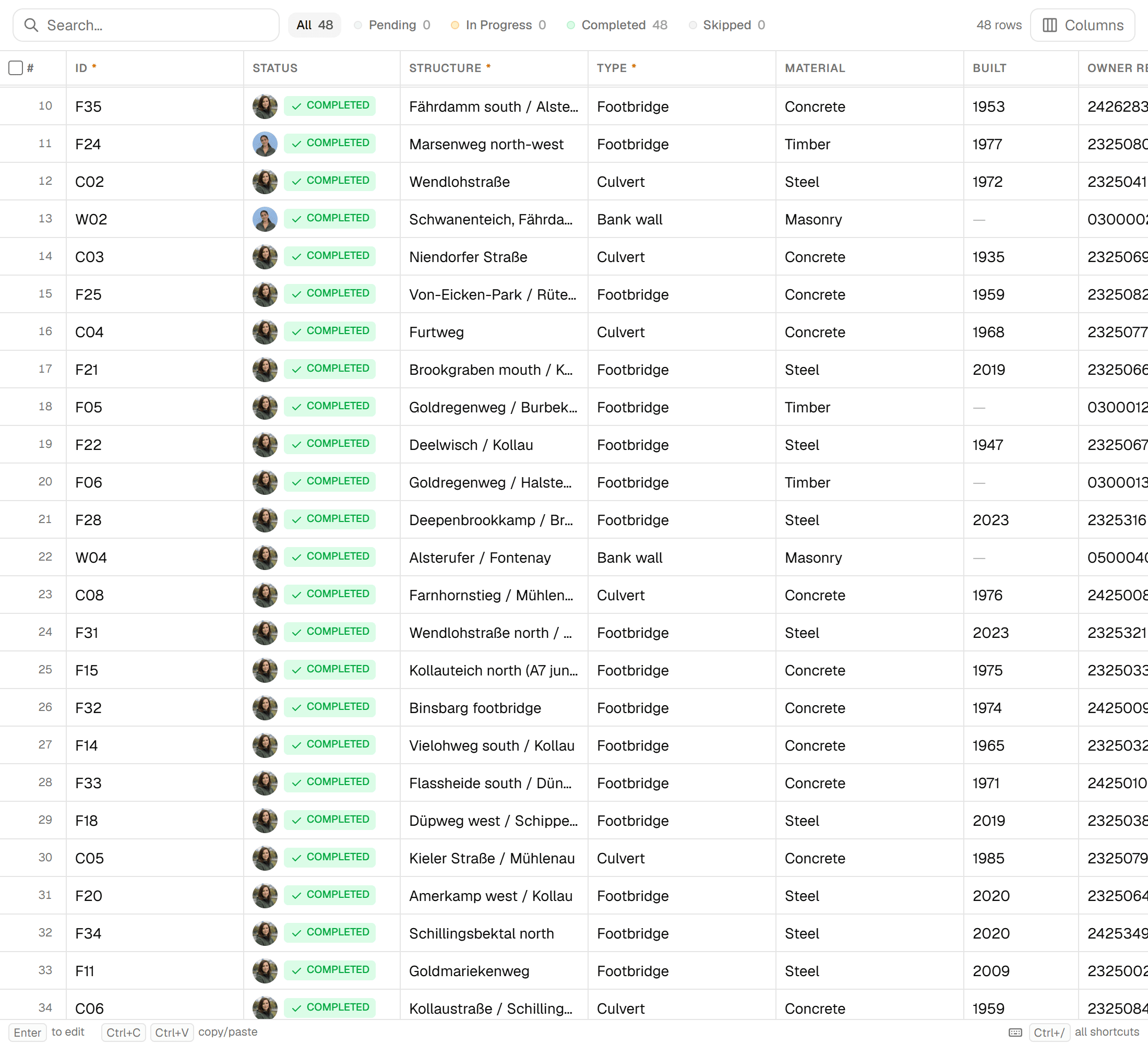
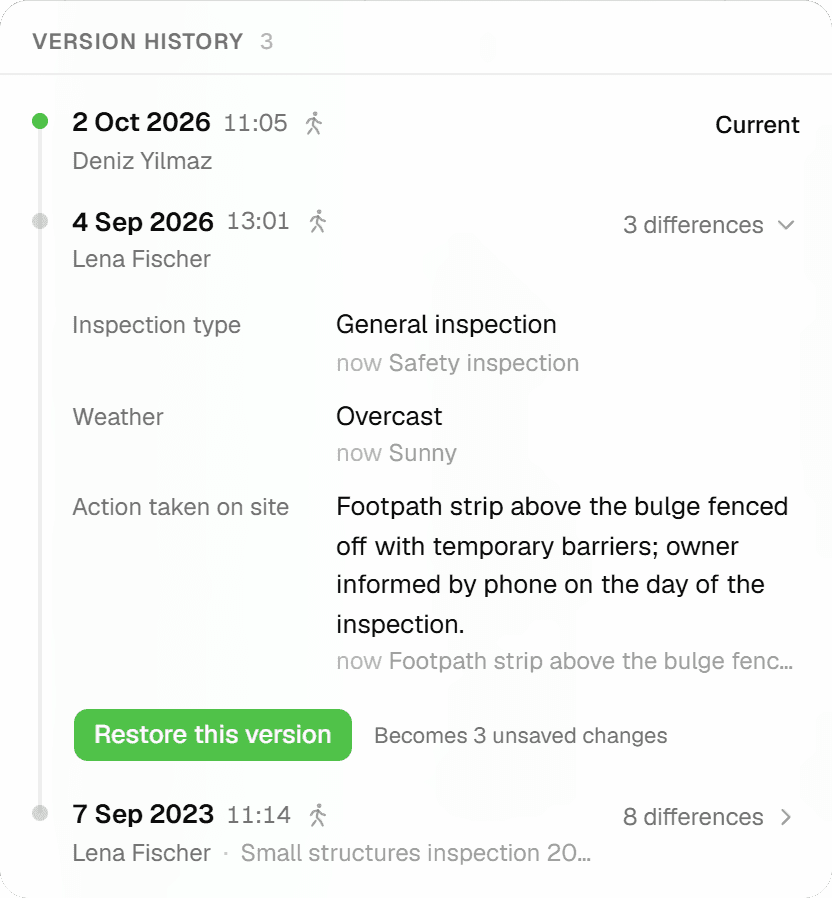
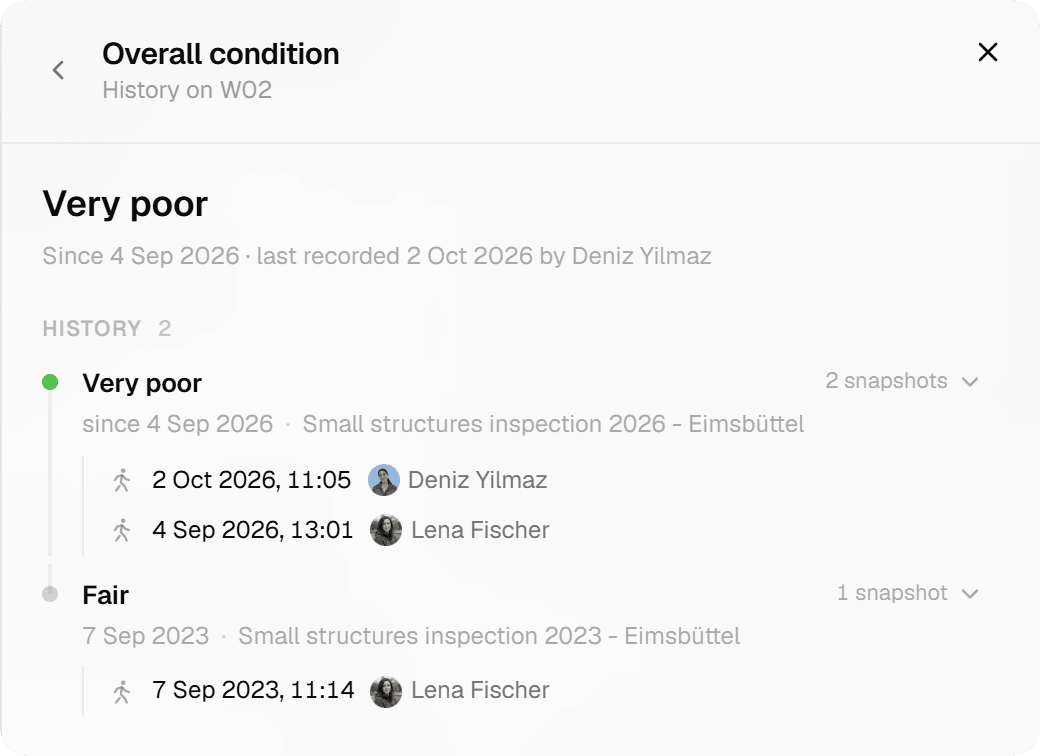
A real screen from the demo workspace, shown on a round of small structures: the versions of one record and one field in two inspections. A memorial's record reads the same way.
What the record of a memorial holds
The ICCM guidance lists what to write down for each memorial, and the Scottish guidance adds to it. The memorial form in the marketplace holds the fields below. Add fields of your own, such as heritage designation or the notice to the owner, in your copy of the form.
Where it stands
Memorial reference, section or block and grave number, and the surname on the stone. Together with the point on the plan, anybody can find the memorial again.
What it is
Memorial type, from lawn headstone to war memorial, the material, the height band and how it is fixed.
What you saw
Visual condition, how far it leans and which way, the joints, the foundation and the defects found, and whether it was safe to test at all.
The hand test
The method used, whether anything moved and how much, and the result: pass, pass within tolerance, fail or not tested. A field takes the force if your policy uses a topple tester.
Category and action
The risk category from 1 to 3, the action taken at once, such as a warning notice, a cordon or a temporary support, and when the memorial is to be inspected again.
Who, when, and the evidence
Inspector, inspection date, comments, photos and a signature. Every submission also carries the account that made it and the time.
As published, the form asks for a photo and a signature at every memorial. The ICCM guidance advises photographing only where there is something to show: make both optional in your copy if your policy says the same. The form's height bands and re-inspection options are a starting point; set them to your policy.
Who inspects, and where the burial register comes in
Inspecting memorials is one job; holding the deeds and writing to the owners is another. Geocadra records the first and hands its results to whoever does the second.
Burial authorities
Your own trained staff walk the sections with the form. You open the project and read which memorials were made safe, and you have the record to hand when a family or the Ombudsman asks what was done and why.
Independent memorial assessors
If you test for several authorities, each one is an organization in your workspace with its own cemeteries and its own records. The authority's cemeteries officer is invited as a viewer and reads the results on a free viewer place.
Parish councils and parochial church councils
A small burial ground rarely comes with cemetery software. A scanned plan, the memorials set on it and the form are enough to run the programme and to keep its record. Work to a memorial in a Church of England churchyard usually needs a faculty: ask the diocese first.
Next to your cemetery system
A burial register system holds the deeds and the owners' addresses, and some have an inspection module of their own. If yours does not, the round goes out as Excel with section and grave number. Filter it to the failed memorials for the letters and the list on your website.
Three rounds in a cemetery
The two memorial rounds start from the memorial form in the Geocadra marketplace. Change its option lists to the words of your policy. The grounds walk needs a short form of your own.
The rolling memorial inspection
The sections due this year are inspected memorial by memorial: a visual check, the hand test, a category and, where needed, a make-safe action on the spot.
- 1Put up the notices your policy asks for, then create the year's project with the memorial form on the sections that are due.
- 2At each memorial record the visual condition, the hand test and the category.
- 3For a memorial that fails, record the action taken and when it is to be inspected again.
- 4Export the round to Excel and filter it to the memorials that failed, or to the categories your policy writes to owners about.
Re-inspecting memorials made safe
A stake, a cordon or a warning notice is temporary. The memorials that carry one are inspected again sooner than the rest of the cemetery.
- 1In last year's round, filter the grid to the memorials with an action recorded.
- 2On the layer's Data tab, tick those memorials and create a project from the selection.
- 3Record the new condition, hand test result and category. Note in the comments whether the mason has re-fixed the memorial and whether the support still holds.
- 4The memorial's history now shows the failure, the temporary support and the repair, in order.
The safety walk of the grounds
Paths, steps, walls, gates, water points and benches are the operator's too. They are further layers in the same project, with a form of their own.
- 1Draw or import the paths as lines and the steps, taps, benches and gates as points.
- 2Build a short form in the form builder: object type, condition, defect, hazard, action, deadline and photo. A German form for the grounds walk is in the marketplace.
- 3Walk the grounds in the same visit as the memorial round, or on its own cycle.
- 4Export the layer to Excel and filter it to the rows with a deadline: that is the work list for the grounds team.
Guidance behind the memorial form
The English memorial form follows the order of the ICCM guidance of 2019 and the Ministry of Justice guidance of 2009. It is a record of the inspection, not a certificate of safety.
A visual check before any test
Condition, lean, joints, foundation and defects come first, with a question whether the memorial is safe to test at all.
The hand test is the main test
The method is a hand test, a visual check only, or a mechanical force where your policy uses one. The result is recorded separately from the method.
Three categories
Category 1 for immediate action, 2 for a memorial that is not an immediate danger, 3 for a stable one, as the ICCM guidance uses them.
Make safe before laying flat
The actions run from none through warning notice, cordon and stake and band to laying flat and referral to an engineer, so the least intrusive one that works can be recorded.
The German yearly test
A separate German form follows the yearly stability test under the accident-prevention rule for cemeteries, with test load, test height and direction.
Standards this page covers
Each standard below has its own page with the inspection regime, the rating system and the form on the marketplace.
Related inspections
The same client usually has these rounds too. Each has its own page.
Questions from cemeteries officers and clerks
How often does the guidance say to inspect every memorial?
The ICCM guidance and the Local Government Ombudsman say at least every five years. The ICCM guidance adds every twelve months for a memorial that is not an immediate danger but not stable. The Ministry of Justice guidance leaves the frequency to the operator. In Scotland scheduled inspections have been a duty since March 2025, without a fixed interval.
Do we need a topple tester for memorial safety testing?
The guidance does not ask for one as a routine. The Ministry of Justice guidance does not recommend routine mechanical testing, the Health and Safety Executive says there is no requirement for it, and the ICCM guidance leaves a device to your discretion. The form has a field for the force if your policy uses one.
Can we lay unsafe memorials flat?
The guidance treats that as a last resort. It puts a warning notice, a cordon or a temporary support first, and the Ombudsman called it inappropriate to lay down every memorial that moves. Whatever you do, the form records it with the date and a photo.
How do we tell the grave owners?
That stays with your office and your register: letters to known owners, a notice on or near the memorial, a list at the gate and on the website. Geocadra gives you the round as Excel, with section, grave number and result, to filter to the failed memorials.
How does Geocadra work alongside our burial register?
It holds the memorial, its place on the plan and every inspection of it. It exports each memorial with its latest inspection as Excel or as a GIS file for the system that holds deeds, bookings and fees.
Our inspector is a contractor. Can they work in our project?
Yes. Invite the assessor to the project as an editor, on one of your seats; they record at the memorial and you read each result once it is submitted. Or the assessor keeps your cemetery as a client organization in their own workspace and invites you as a viewer.
We only have a paper plan. Is that enough?
Yes. Scan it as a PDF or an image, place it on the map as a georeferenced backdrop and set the memorials on it as points, section by section. From then on the plan and the inspections are in one place.
Does it work for a churchyard?
As a record, yes: the memorials, the inspections and what was done. Work to a memorial in a Church of England churchyard usually needs a faculty, and that is for the diocese, not for software.
Where is our data stored?
Your projects, photos and files are stored in Frankfurt, Germany. AI features, such as the report draft, are processed by providers in the US.

Start this year's memorial inspection with one section
Bring the plan of one section, copy the memorial form and inspect the first row today. Free for 14 days, no credit card.
No credit card requiredFree trial included