

Form
Tree inspection form: what to record for every tree
The fields of a tree inspection record, the defects to look for from crown to roots, and how an inspection form differs from a tree risk assessment form. Download it as a PDF or an Excel file, or use it as a form on the map.
- Free PDF and Excel file
- Inspection, risk assessment or survey
- One record per tree, kept over the years
The fields of a tree inspection record
Whatever method you follow, a record that can still be read a year later has the same six parts. If you came for the ISA Basic Tree Risk Assessment Form itself: ISA publishes it at isa-arbor.com. This page is not that form; it shows what such forms record.
The form as a sheet for one tree
The fields of the record with room to write, the defect list with three columns to tick, and a table for the work recommended. The Excel file adds a register with one row per tree.
Editions it names: ISA Basic Tree Risk Assessment Form, instructions © 2025 · FLL Baumkontrollrichtlinien, 3rd edition, 2020
PDF: A4, 3 pages, 223 KB · Excel: 228 KB
PDF and Excel, free. No sign-up, no e-mail address.
Which tree, who, when
A tree number that is on the tree, on the map and in the inventory; the species; the inspector, the date and whether the tree was in leaf.
Its size and stage
Stem diameter, height, crown spread and the life stage from young to veteran. They put a defect in proportion.
What it could hit
The targets: everything the tree or a branch could reach if it fell, and how often people are there. A dead branch over a meadow is not a dead branch over a school gate.
Condition and defects
Vitality on a scale you keep to (for example good, fair, poor, dead), then the defects by tree part, each with a photo.
The verdict
Whether the tree needs no work now, needs work or needs a closer examination, with a risk rating where the method has one.
Work and next inspection
The work recommended and its urgency (for example at once, within a month, within a year), the date it was done, and when the tree is due again.
Tree inspection checklist: what to look for, crown to roots
The defect list most forms share, grouped by tree part. It is a prompt, not a complete list: record what you see, even if it is not on the list.
Crown and branches
Look up first, from two sides, with binoculars where the crown is high.
Dead branches
Their size and what they hang over. Note the diameter of the largest one above a target.
Broken or hanging branches
Lodged in the crown or partly attached: these are the urgent ones.
Weak unions
Forks with included bark, codominant stems, cracks running down from the union.
Dieback and thin foliage
Dead tips, small or yellowing leaves, a crown you can see through in summer.
Overextended or heavy limbs
Long horizontal limbs with their weight at the end, and earlier failures of similar branches on the same tree.
Past pruning
Topping, lion-tailing, large old wounds and the regrowth they left behind.
Clearance over road and path
Branches below the clear height the highway authority asks for, or hiding signs, signals and street lights.
Pests and disease
Signs you can name, such as ash dieback or the nests of oak processionary moth. Record what you saw, not a diagnosis you cannot support.
Trunk
Walk round it. Sound it with a mallet where something looks or feels wrong.
Cavities and decay
Openings, soft or hollow-sounding wood. Estimate how far round the stem it reaches.
Fungal fruiting bodies
Brackets and mushrooms on the stem. Photograph them: the species decides what they mean.
Cracks and splits
Vertical cracks, shear cracks, bark pushed apart by movement.
Dead or missing bark
Impact damage from vehicles and mowers, lightning scars, bleeding or ooze.
Lean
The angle, and whether the tree has grown upright above it or the lean is new.
Root collar, roots and soil
Clear leaves and ivy away. If the root collar is buried, say so in the record.
Fungi at the base
Fruiting bodies on the buttress roots, or coming up from the roots nearby.
Root plate movement
Lifted soil, cracks in the ground, a gap opening on the side away from the lean.
Cut or damaged roots
Trenches, new kerbs and paving. Note how far from the trunk the roots were cut.
Fill, girdling roots and compaction
Soil piled against the stem, roots circling and constricting its base, sealed surfaces, vehicles parked on the root zone.
Site and targets
What the tree could hit decides the risk.
What is in reach
Roads, paths, benches, buildings and overhead lines under the crown and within the distance the tree could fall.
How often people are there
Rare, occasional, frequent or constant.
Recent changes
Neighbouring trees removed, new exposure to wind, building work, changed drainage.
Habitat
Nest holes, likely bat roosts, veteran features. They limit when and how work can be done.
The grouping follows the layout that the ISA Basic Tree Risk Assessment Form and the German FLL guideline share. The list does not replace training, and it is not the ISA form.
- Site or street
- Date
- Inspector
- Signature
Tree inspection form, tree risk assessment form or survey schedule?
Four documents get called a tree form. Which one you need depends on the question being asked of the tree.
| Document | When you need it | What it adds | Who fills it in |
|---|---|---|---|
| Tree inspection record | Routine safety checks of the trees you are responsible for | Condition, defects, work and the date of the next inspection | An inspector with sound general tree knowledge |
| Tree risk assessment form | A tree has a defect and a target, and someone has to rate the risk | Likelihood of failure, likelihood of impact and consequences, combined into a rating from low to extreme | A qualified assessor; for the ISA form usually someone holding TRAQ |
| Tree survey schedule | A site is to be developed and the trees are a planning matter | Dimensions, a quality category and a root protection area per tree, for the drawing | An arboriculturist; in the UK to BS 5837 |
| Advanced assessment | The basic assessment cannot settle the question | Measurements: decay detection, a climbing inspection, a pull test | A specialist, on instruction |
The ISA form covers a Level 2 (basic) assessment. Level 1 is a limited visual assessment, for instance a drive-by; Level 3 is advanced. ISA's instructions give the time frame of an assessment as typically one to five years and say the form alone is not a report.
The methods behind the form
Each method has its own page: what it rates, on which scale, and what its form records.
- ISA TRAQ Tree Risk AssessmentThe method behind the ISA Basic Tree Risk Assessment Form: two matrices and four risk ratings.
- QTRA Tree Risk AssessmentThe quantified approach common in the UK: the risk of harm expressed as a probability.
- VTA Mattheck Tree AssessmentVisual Tree Assessment: reading a tree's body language for signs of defects, the basis of most inspection lists.
- BS 5837 Tree SurveyThe British Standard for trees on development sites: the survey schedule, the categories and the root protection area.
- Matheny & Clark Tree Hazard EvaluationThe older 12-point hazard rating still found on many municipal forms in the United States.
The form on the map, the record on the tree
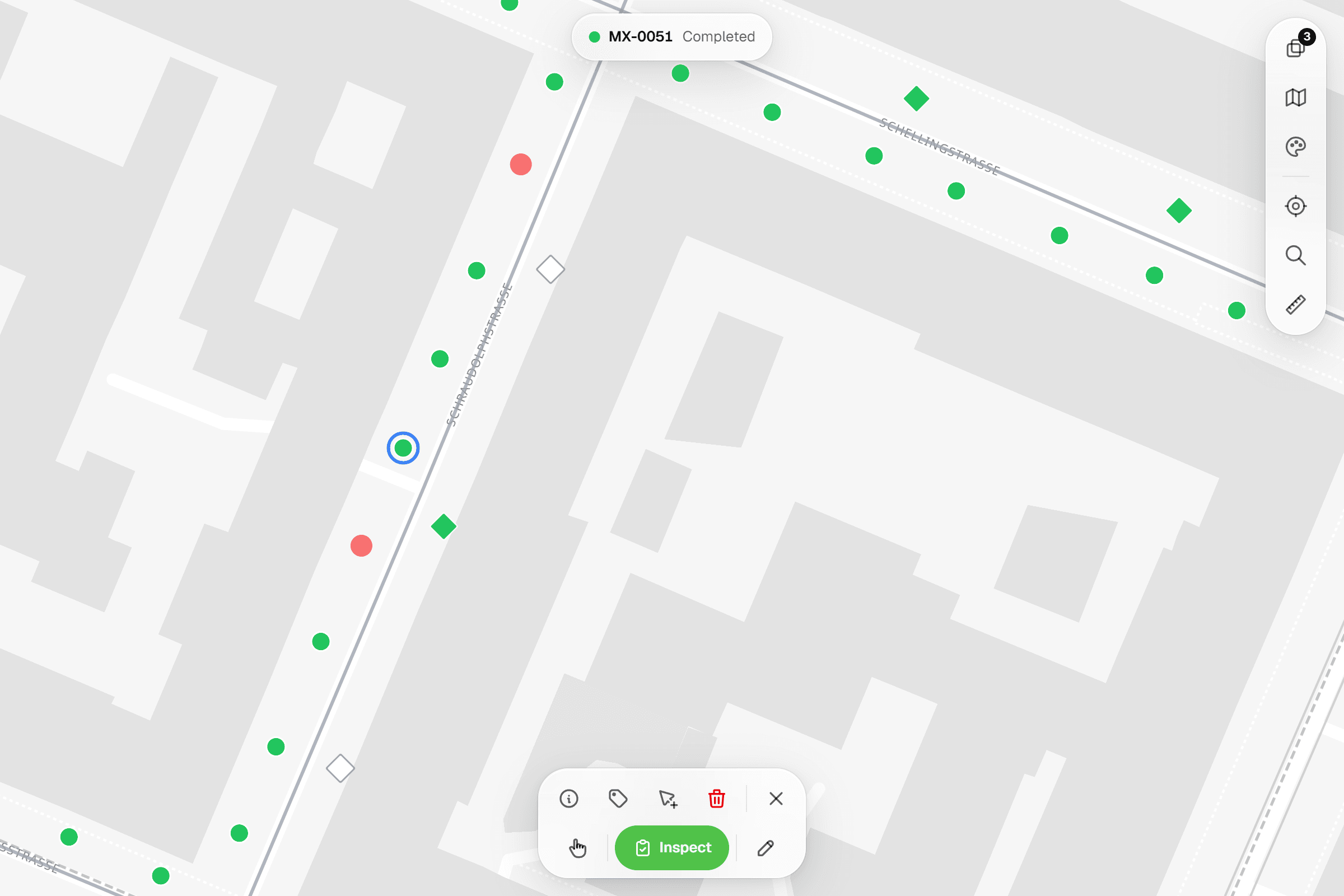
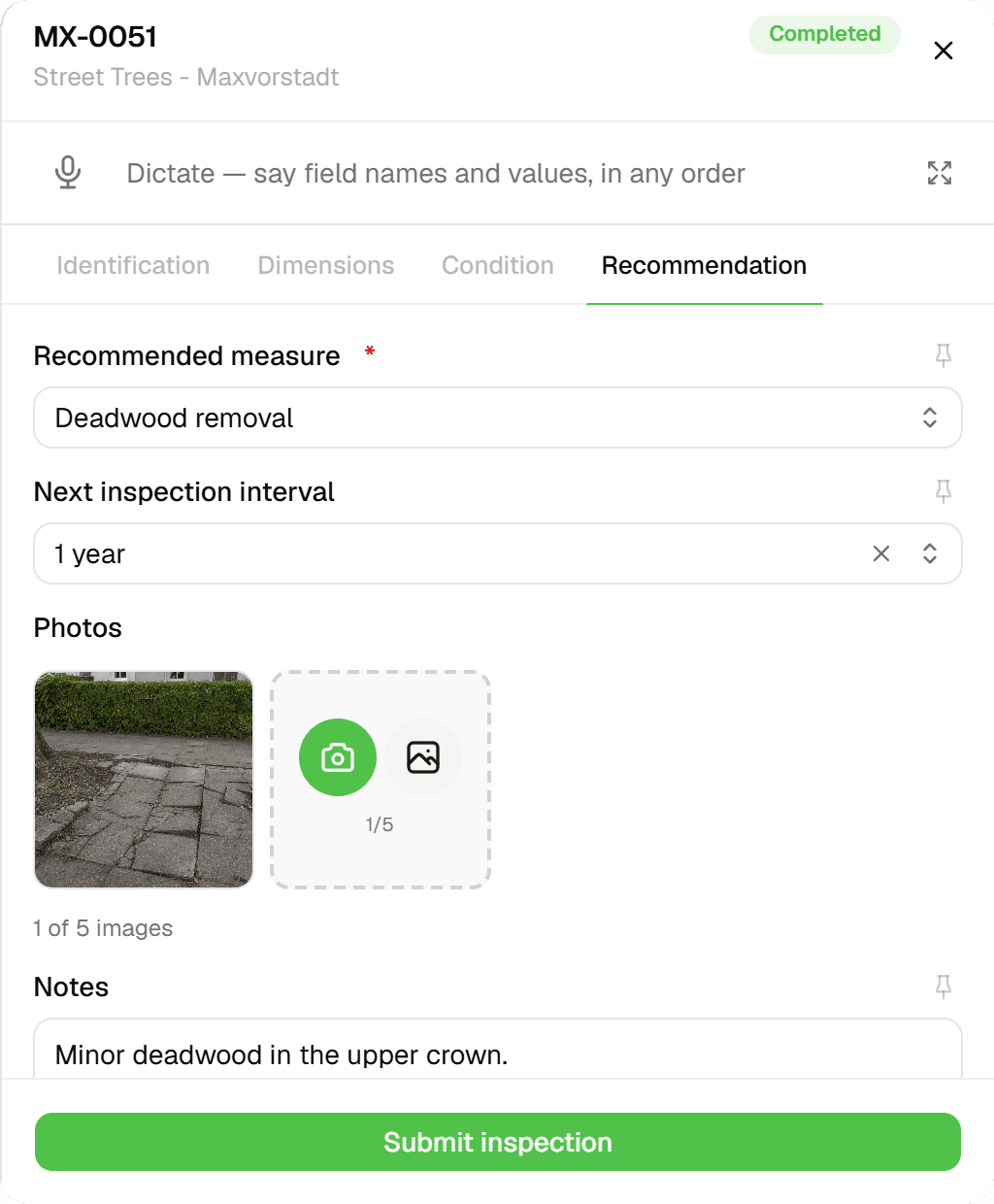
A tree inventory is a layer of points. In Geocadra you tap a tree on the map and its inspection form opens; what you record, with the photos of each defect, is added to the inspection history of that tree.
Start from a ready form
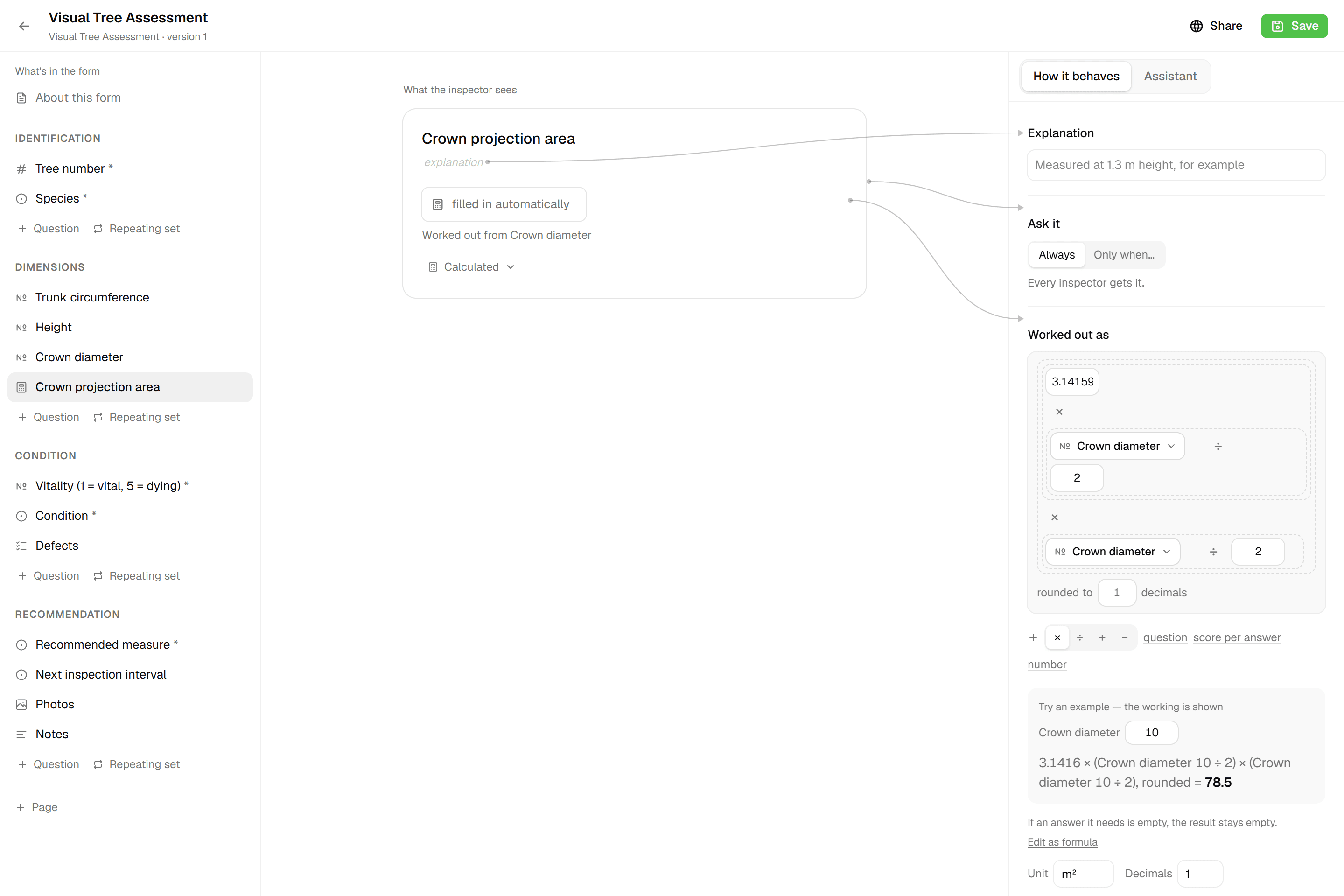
The form marketplace holds a risk assessment form modelled on the ISA form, with both matrices worked out by calculated fields, a BS 5837 survey form and the German FLL inspection form. Copy the one nearest to your method and change its lists.
Bring the inventory you already have
Import the inventory as Shapefile, GeoPackage or CSV, or from the client's CAD drawing. The trees stand on the map with their numbers.
The next round starts with the last
Every inspection stays on the tree with who and when, and one field can be followed across the years.
Back to the client in their format
Excel, Shapefile or GeoPackage for the inventory, and a CAD drawing with a ring per tree for the crown or the root zone.

What makes a tree record useless a year on
Five things that leave the next inspector guessing.
No number on the tree
The record says T-114 and the avenue has forty limes. Without a tag on the tree or a point on the map, the next inspector guesses.
Defects without a verdict
A list of observations does not say whether the tree is safe. End every record with a decision.
Work recommended, never closed
‘Remove deadwood’ with no urgency and no completion date comes back on every round. Record when the work was done.
Only the trees with defects recorded
In a busy zone, a short entry with no findings shows the tree was looked at. Agree with the owner which zones need a record per tree and which do not.
The form handed over as the report
ISA's own instructions say the form is not a report. A client usually needs the findings in words, the photos and a plan.
Questions about tree inspection forms
Where do I get the ISA tree risk assessment form?
The ISA Basic Tree Risk Assessment Form and its instructions are published by the International Society of Arboriculture on isa-arbor.com. This page does not reproduce it; it explains what such a form records. The risk assessment form in Geocadra is modelled on it and is not an ISA product.
Is there a tree inspection form to download?
Yes, free. The PDF is a sheet for one tree: the record with room to write, the defect list to tick and a table for the work recommended. The Excel file adds a register with one row per tree. It is not the ISA form; ISA publishes that one at isa-arbor.com.
What is the difference between a tree inspection and a tree risk assessment?
An inspection looks at condition and defects and ends in work and a date for the next visit. A risk assessment takes a defect and a target and rates the risk: how likely the part is to fail, how likely it is to hit something, and how bad that would be. Many owners inspect all their trees and assess only those where the inspection found something.
How often should trees be inspected?
It depends on the tree and on what is around it. Many owners zone their land by use and inspect busy zones more often. As one published example, the German FLL guideline sets one to three years by condition, age and use. An ISA risk assessment names its own time frame, typically one to five years.
Who can fill in a tree inspection form?
UK guidance from the National Tree Safety Group has described formal inspections as needing general tree knowledge rather than a specific qualification, and detailed inspections as work for an appropriately competent expert. A formal risk assessment on the ISA form is usually done by someone holding ISA's Tree Risk Assessment Qualification. Agree with the tree owner who inspects which trees.
Can I fill in the form on a phone or tablet?
Yes. Geocadra runs in the browser on a phone or tablet, and you open each tree's form from the map. An Android app that queues inspections without signal until it is back online is in early access.
Does a completed form prove the owner met their duty of care?
No form can promise that. A record shows what was inspected, when, by whom and with what result, which is what an owner is usually asked for. Whether it is enough in a given case is a legal question, and this page is not legal advice.
More checklists and templates
Each page carries its document in full and links the standards it is drawn from.

Inspect your first tree on the map
Bring your tree inventory, choose a form and walk the first street. Free for 14 days, no credit card.
No credit card requiredFree trial included