

Checklist
Playground inspection checklist, by inspection level
A playground inspection checklist that follows the three inspection levels: what to check on the routine round, at the operational inspection and at the annual main inspection. Download it as a PDF or an Excel file, or run it as a form on the map.
- Three inspection levels
- Every defect on its piece of equipment
- EN 1176, ASTM F1487 and CPSC
Playground safety checklist, level by level
Each level includes the one before it. On the printed sheet, tick each point once for the site and give every defect the number of its equipment. In the form, work through the list per piece of equipment, and keep the points that belong to the whole site (gate, sign, litter) as one more entry.
The checklist as a sheet to print
The same points with three status columns, a table for defects and their follow-up, and a line to sign. Print it for the round, or adapt the Excel file, which adds an equipment list, to your own equipment.
Editions it names: EN 1176-7:2020 · CPSC Public Playground Safety Handbook, Publication 325, July 2025 · CPSC Public Playground Safety Checklist · ASTM F1487-25 · RoSPA Play Safety
PDF: A4, 3 pages, 223 KB · Excel: 218 KB
PDF and Excel, free. No sign-up, no e-mail address.
Routine visual inspection (daily to weekly)
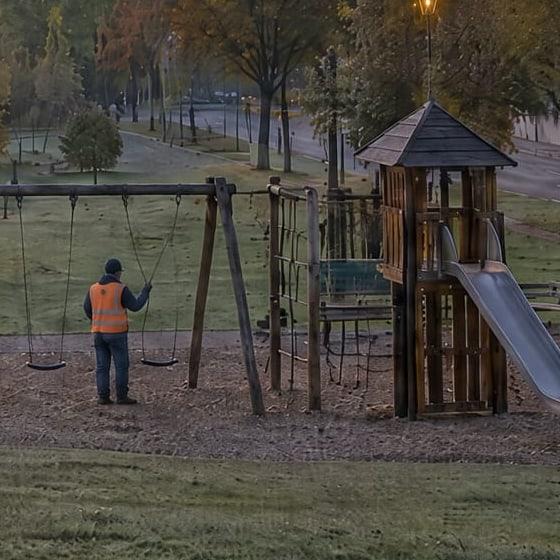
The walk-round. A few minutes per site, done by the person who is there anyway.
Litter, glass and sharp objects
Broken glass, needles, cans and animal fouling on the surfacing and in the sand. Remove it on the spot or record it.
Surfacing by eye
Loose fill kicked out under swings and at the foot of slides; holes, lifted edges or gaps in rubber surfacing; standing water.
Broken or missing parts
Seats, steps, rungs, panels, handgrips and end caps: anything snapped, bent or gone since the last round.
Exposed foundations
Concrete footings or anchors showing above the surfacing: a trip hazard and a hard edge where a child can land.
Protruding nails, bolts and splinters
Anything a hand, an eye or a piece of clothing can catch on.
Trip hazards
Roots, stumps, rocks, raised edging and anything left lying in and around the play area.
Ropes and cords tied on by users
Skipping ropes, dog leads or cords tied to equipment are a strangulation hazard. Take them down.
Gate, fence and sign
The gate closes by itself, the fence has no gaps, and the sign with the operator's contact and the emergency number is there and readable.
Operational inspection (every one to three months)
Everything on the routine list, plus the checks that need hands on the equipment.
Stability
Push and pull every post, frame and platform. Movement at the base means a loose fixing, a cracked footing or decay below ground.
Chains, shackles and S-hooks
Wear at the top links and connectors, where metal runs on metal. An S-hook has to be closed: the CPSC handbook counts a gap over 0.04 in, the thickness of a dime, as open.
Bearings and pivots
Swings, roundabouts, seesaws and spring rockers: noise, play, seizing, cracked springs.
Ropes and nets
Fraying, cut strands, an exposed steel core, loose clamps.
Fixings
Bolts and screws tight and complete. Note what you tightened or replaced.
Timber, metal and plastic
Cracks and soft spots in timber, flaking rust on steel, brittle or cracked plastic, glass fibres showing on slides made of glass-reinforced plastic.
Crush and shear points
Moving parts that can pinch or crush a finger: seesaw pivots, the edge of a roundabout, the joints of a suspension bridge.
Loose-fill depth
Measure at the worn spots, not at the edge, and record the lowest reading. The CPSC handbook (July 2025) says never to keep less than 9 in of wood chips, mulch, sand or pea gravel (12 in when first filled), or 6 in of rubber mulch.
Guardrails and barriers
Present and firm on every platform, with no panel or rail missing.
Annual main inspection (once a year)
Done by a competent inspector. The list shows what the report should cover, so you can brief the inspector and read the result. It does not replace the inspector.
Foundations and anchoring
Footings dug out where needed: cracks, corrosion at the post shoe, posts decayed at ground level.
Rot and corrosion in load-bearing parts
Timber probed or drilled where decay is suspected; steel checked for loss of section, not just surface rust.
Entrapment, with probes
Head, neck, finger and clothing traps tested with the standard's probes, not judged by eye. The CPSC checklist flags openings between 3.5 and 9 in.
Impact area and surfacing
The free height of fall against the surfacing's rated critical fall height, the extent of the impact area, and obstacles inside it.
One-post equipment
Items standing on a single post get their own check of the post below ground.
Repairs and changes since the last main inspection
Whether replaced parts and modifications have changed the safety of the equipment.
Extent of the surfacing
Protective surfacing that reaches far enough beyond the equipment. The CPSC checklist asks for at least 6 ft in all directions, and more in front of and behind swings.
The points are drawn from EN 1176-7, the CPSC Public Playground Safety Handbook (July 2025) and the published advice of RoSPA and the public checklist of the CPSC. A checklist does not make an inspection conform to a standard and does not qualify the person using it.
- Play area
- Date
- Inspector
- Signature
Playground inspection levels: who checks what, and how often
Most checklists you can download are one list for one visit. A playground is inspected at three depths by three kinds of people, and once more after it is built or altered. Each has its own points.
| Inspection | How often | Who | What it finds |
|---|---|---|---|
| Routine visual inspection | Daily to weekly, by how heavily the site is used | Someone briefed for it: caretaker, groundskeeper, site staff | Obvious hazards from vandalism, use or weather: broken parts, glass, displaced surfacing |
| Operational inspection | Every one to three months, or as the manufacturer states | A person trained for it | Wear and stability: chains, bearings, fixings, how the moving parts work |
| Annual main inspection | Once a year | A competent inspector, in many places independent of the operator | The overall safety of equipment, foundations and surfacing, including rot and corrosion |
| Post-installation inspection | Before a new or altered play area opens | A competent inspector | Whether equipment and surfacing were installed as the standard and the manufacturer require |
The levels are those of EN 1176-7:2020; the frequencies are how operators in Europe and the UK commonly apply them. The standard fixes no interval for the routine visual inspection. In the United States the CPSC handbook sets no fixed interval: follow the manufacturer's schedule and inspect busy playgrounds more often. US practice often calls the quick custodial round a high-frequency inspection and the hands-on one a low-frequency inspection. Local rules and the manufacturer's instructions can ask for more.
What a playground inspection form records
A tick sheet per playground says the round was done. A record per item says what was found on the swing by the gate, and what happened next.
The item, by its ID
A number on the equipment and the same number on the map. ‘Swing 2’ means nothing a year later.
Inspection type, date, inspector
Which of the levels this was, when, and who did it.
Each defect by component
Chain, seat, bearing, post, surfacing: what is wrong and where on the item, with a photo.
A risk rating
Very low to very high, or the priority 1 to 4 many US agencies use. It decides what waits and what closes today.
The action and its date
What has to happen and by when. Later, the date it was done and by whom.
Whether it stays open
Open, open with a restriction, or closed until repaired, and how it was closed off.
The standards behind the checklist
The round is much the same everywhere; the standard decides the numbers and the words. Each page explains one standard and what its form records.
- EN 1176 Playground InspectionEurope and the UK. The inspection levels come from Part 7; in the UK it is applied as guidance.
- ASTM F1487 Playground SafetyUnited States, public playgrounds: use zones, fall heights and entrapment tests for the equipment.
- CPSC 325 Playground SafetyUnited States. The handbook many schools and parks departments inspect against, with its own maintenance checklist.
- CSA Z614 Playground SafetyCanada. The national standard for children's play spaces and equipment.
- AS 4685 Playground InspectionAustralia. The AS 4685 series, built on EN 1176 with local changes.
Where playground records fall short
The inspection is rarely the problem. The record is.
One tick sheet for the whole site
It shows somebody walked round. It cannot show which swing had the worn chain. Record per item, and keep the site-wide points as one more record.
A defect with no follow-up
A finding without a date for the repair, and without the date it was done, stays an open question. Give every defect an action, a deadline and a closing entry.
The annual report in a drawer
The inspector's PDF lists thirty findings and the crew's list has none of them. The findings belong on the same items the routine round visits.
An old edition on the form
Forms that cite the 2010 CPSC handbook are still in circulation. The handbook was revised in July 2025 and ASTM F1487 in 2025. Check which edition your form names.
Closing with tape
A sign and barrier tape do not stop use. Take the seat off, fence the item or remove it, and record which.
The same checklist as a form on the map
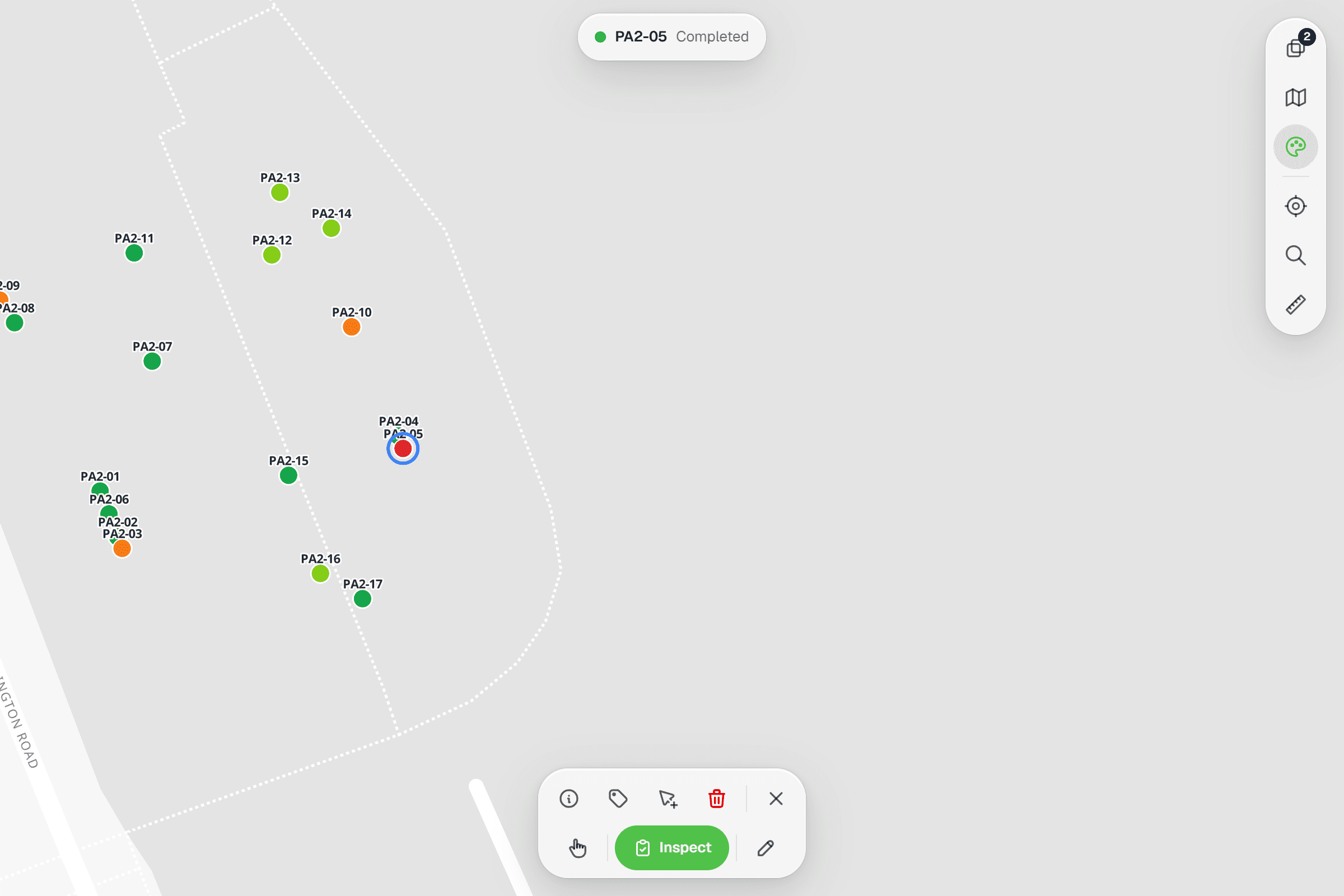
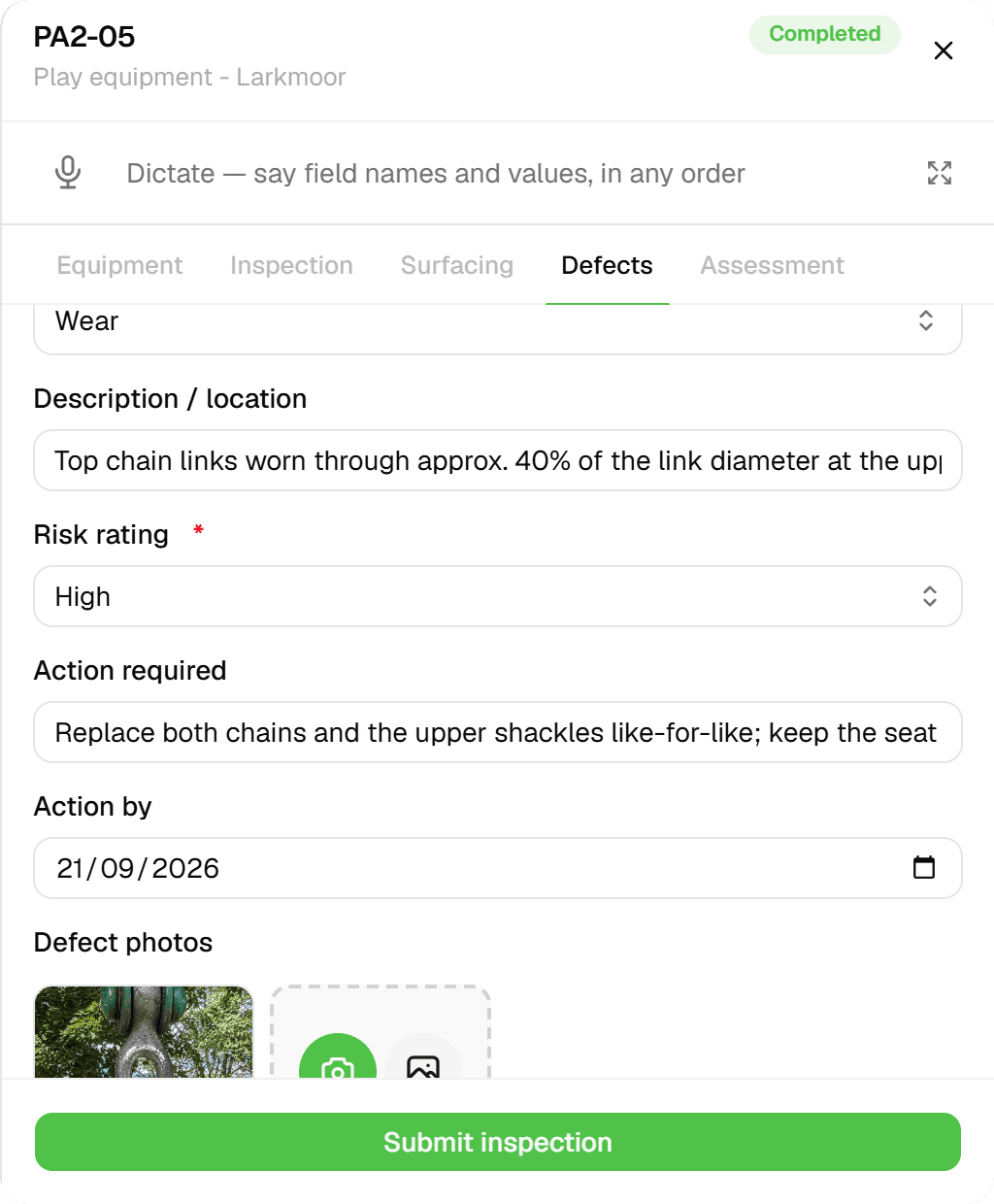
In Geocadra every piece of equipment is a point on the map, and the checklist is its inspection form. The crew taps the item, answers the questions of the round and takes the photos of each defect. The record stays in the inspection history of that item.
A ready form to start from
The form marketplace holds playground forms written to EN 1176-7, to ASTM F1487 with the CPSC handbook, to CSA Z614 and to AS 4685. Copy one into your workspace and change the option lists to your own words.
Defects as a repeating set
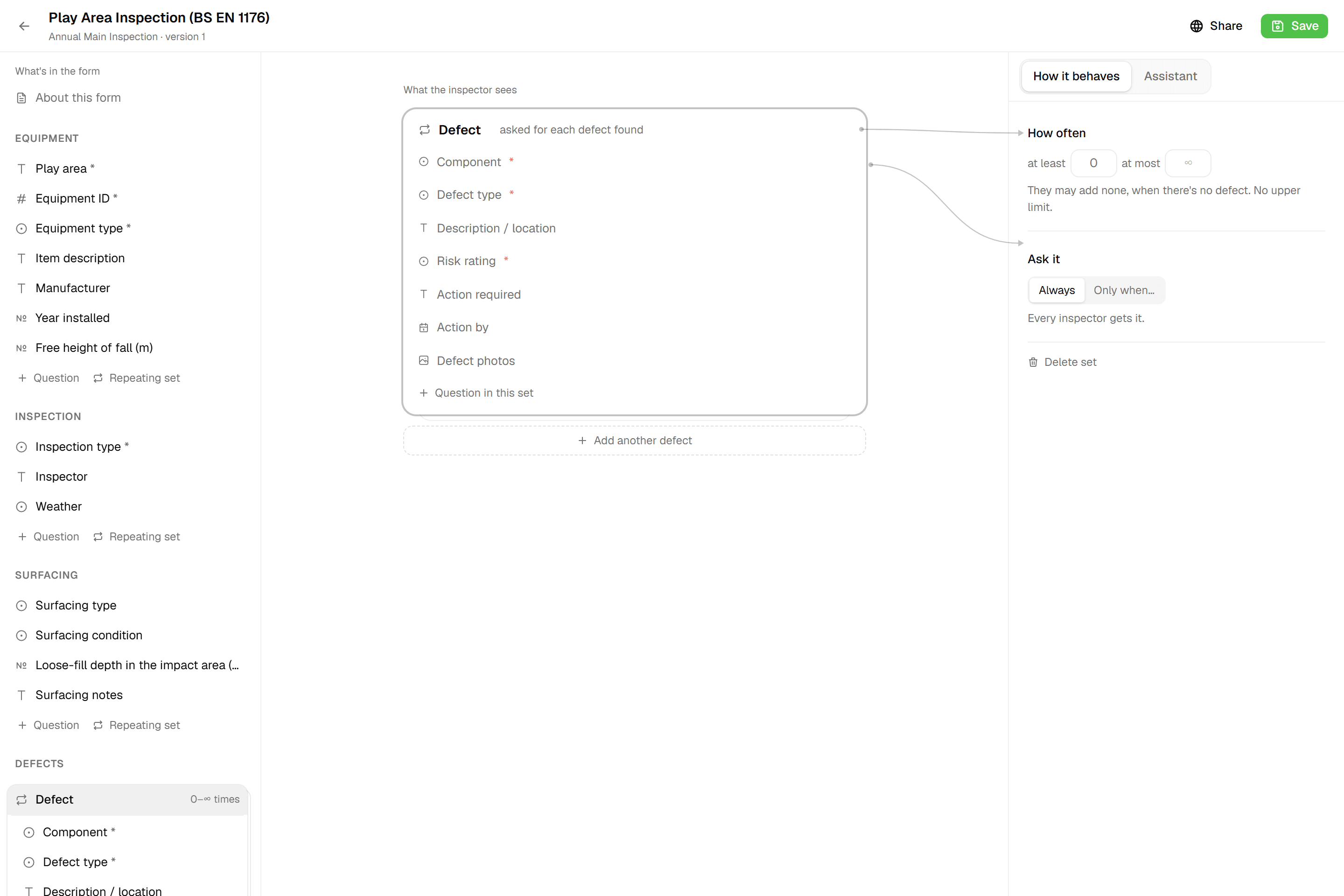
One defect, one entry: component, defect type, risk rating, action, action-by date and photos. No defect, no entry.
Depth checked by the form
A calculated field can compare the loose-fill depth you measured with the minimum for that fall height, and show the shortfall.
The round becomes the report
The inspection report counts items inspected, findings by risk and items closed, and adds the photos. An assistant drafts the text from the inspection data; you read it, change it and finalize the PDF. What such a report has to contain is on the inspection report template page.

Questions about playground inspections
How often should a playground be inspected?
EN 1176-7 works with three levels: a routine visual inspection, in practice daily to weekly by use, an operational inspection every one to three months or as the manufacturer states, and a main inspection once a year. The US CPSC handbook sets no fixed interval; it says to follow the manufacturer's schedule and to inspect heavily used playgrounds more often. Your insurer, local rules or the manufacturer may ask for more.
Who can carry out a playground inspection?
The routine round can be done by briefed site staff. The annual main inspection needs a competent inspector: in the UK usually one on the RPII register, in the US a Certified Playground Safety Inspector (CPSI), in Germany a qualified inspector under DIN 79161. Who is competent for your site is the operator's decision.
Is there a printable playground inspection checklist?
Yes. The checklist on this page is a free PDF: every point with columns for OK, defect and not applicable, a table for defects and their follow-up, and a line for date, inspector and signature. The Excel file is the same sheet to adapt to your own equipment. If you want a record per piece of equipment with photos and deadlines, the same list exists as a form in Geocadra.
How deep should loose-fill surfacing be?
The CPSC handbook (July 2025) gives 12 inches of wood chips, mulch, sand or pea gravel when first filled and says never to keep less than 9 inches, or 6 inches of rubber mulch. In Europe, EN 1176-1 ties the depth to the free height of fall and adds an allowance for material that gets kicked away. Measure at the worn spots and record the lowest reading.
How long should inspection records be kept?
There is no single period. The CPSC handbook says to retain records of all inspections and repairs without naming a time; Berlin's 2026 rule for public playgrounds, as one example, sets five years, counted for the records of a piece of equipment from the day it is removed. Ask your insurer and check local rules. In Geocadra a record stays on its item and is never overwritten.
Does using this checklist mean a playground meets the standard?
No. A checklist is a memory aid and a record of what the inspector saw. Whether equipment conforms to a standard is for a competent inspector to judge, and the operator stays responsible for the site.
More checklists and templates
Each page carries its document in full and links the standards it is drawn from.

Run your next round as a form
Import your play areas, pick a playground form and inspect the first item today. Free for 14 days, no credit card.
No credit card requiredFree trial included