




Checklist
Bridge inspection checklist, component by component
A bridge inspection checklist for bridges, culverts and footbridges: what to look at from the deck down to the channel, and how the US, UK and German systems rate what you find. Download it as a PDF or an Excel file, or run it as a form on the map.
- Deck to channel, by component
- US, UK and German intervals and ratings
- Culverts and footbridges included
Bridge and culvert inspection checklist
In the order you walk it: on top, underneath, then at the water. Note the parts you could not reach as carefully as the parts you could, and work from a safe place: traffic, water and the inside of a culvert each need their own precautions.
The checklist as a sheet for one structure
The same points with three status columns, a table for defects with their rating and their change since the last inspection, and a line to sign. Print it for the visit, or adapt the Excel file to your structures.
Editions it names: 23 CFR 650, Subpart C · FHWA, Specifications for the National Bridge Inventory, March 2022 · CS 450, version 0.1.0, April 2021 · DIN 1076:1999-11 · RI-EBW-PRÜF, edition 2017
PDF: A4, 4 pages, 200 KB · Excel: 180 KB
PDF and Excel, free. No sign-up, no e-mail address.
Deck and approaches
Start on top, where the public is.
Wearing surface
Cracking, potholes, rutting, ponding water. On timber decks, loose or decayed boards.
Expansion joints
Debris packed into the gap, torn or missing seals, a step between the two sides, water leaking on to what is below.
Drainage
Blocked gullies and scuppers, outlets that discharge on to bearings or abutments, staining that shows where the water runs.
Parapets and railings
Impact damage, loose posts, corroded fixings, missing infill or sections.
Footbridge decks, steps and handrails
Slippery or loose boards, worn anti-slip strips, damaged steps and ramps, loose or incomplete handrails.
Approaches
Settlement at the ends of the deck, erosion of the embankment, damaged approach barriers.
Signs
Weight limit and headroom signs present, readable and still correct.
Superstructure
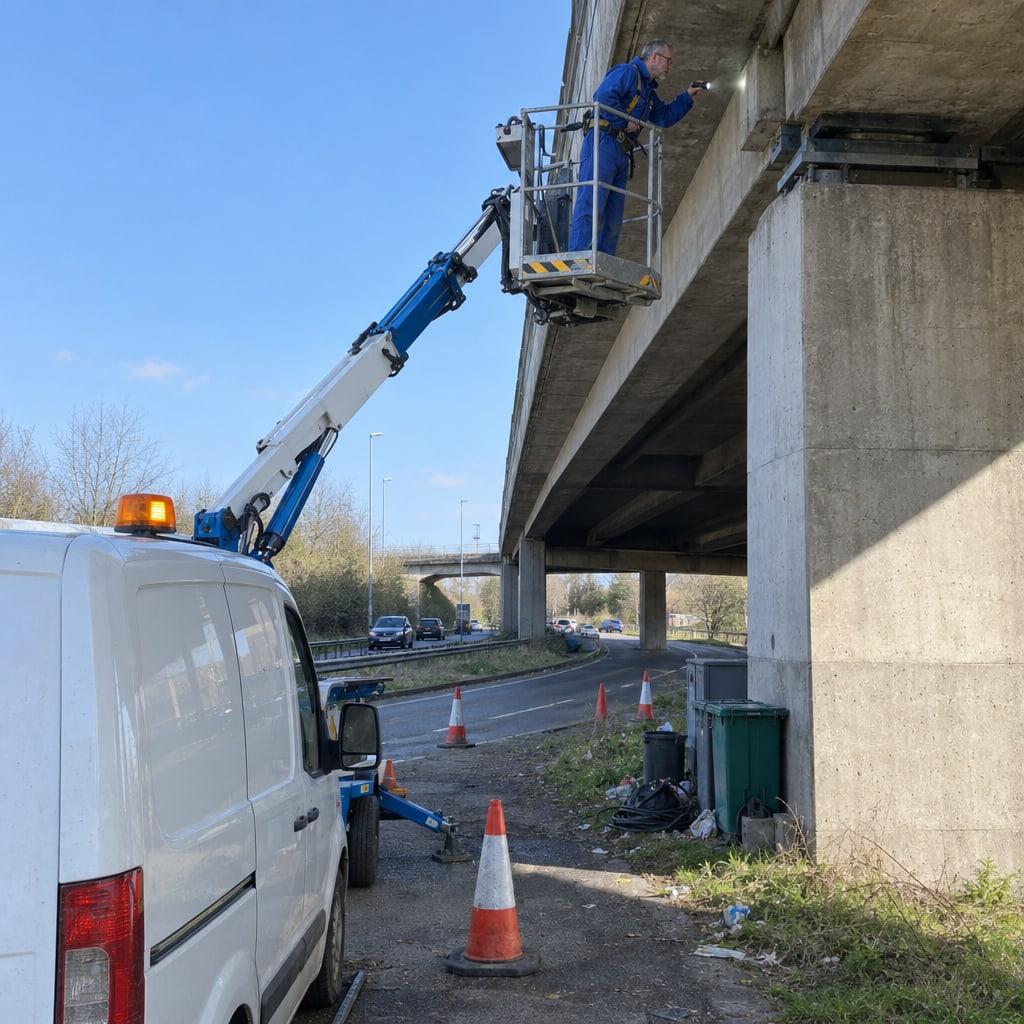
From below, with a torch.
Beams, girders or slab
Concrete: cracks, spalling, exposed or rusting reinforcement. Steel: corrosion with loss of section, cracked welds, loose or missing bolts. Timber: decay, splits, crushing at the supports.
Arch barrel and spandrels
On masonry: open joints and lost mortar, displaced or dropped stones, bulging spandrel walls, rings separating.
Bearings
Seized, displaced or corroded; rubber bearings bulging or split; debris and standing water on the bearing shelf.
Movement and impact
Vehicle strikes on the soffit, sagging, a gap that was not there before.
Substructure
Abutments and piers
Cracks, spalling, tilting or rotation, impact damage at road or water level.
Wing walls and headwalls
Leaning, bulging, separation from the abutment, backfill washed out behind them.
Foundations, where you can see them
Exposed footings, settlement, a gap opening between the structure and the ground.
Vegetation
Roots in joints and trees growing against the structure. Note it before it becomes a defect.
Channel and scour
Scour happens out of sight, and fastest in a flood.
Scour at foundations
Exposed footings or piles, undermining, holes at the upstream end of piers and along abutments. Probe where you cannot see.
Channel
A main channel that has shifted, eroding banks, new bars of gravel or silt.
Debris and blockage
Trees and rubbish against piers or in a culvert barrel, and how much of the opening they block.
Scour protection
Riprap, aprons and invert paving displaced or broken up.
After high water
Walk the structure again once a flood has passed. Scour holes fill back in as the water drops, so probe rather than look.
Culvert inspection checklist
A short span can fall below the threshold of every inspection system.
Barrel
Cracks and open joints, deformation of corrugated steel, corrosion or abrasion along the invert.
Inlet and outlet
Headwalls, aprons, undermining at the outlet, a drop that has formed downstream.
The road above
Sinkholes or settlement in the carriageway: soil is being lost into the barrel.
No single standard publishes this list. It follows the components that inspections under the US National Bridge Inspection Standards, the UK's CS 450 and Germany's DIN 1076 all cover. A checklist does not replace the inspections by qualified engineers that those systems require.
- Structure
- Date
- Inspector
- Signature
Bridge inspection intervals and rating scales, by country
The walk round the structure is much the same everywhere. The system you work under sets the interval and the scale.
| System | Regular inspection | Deeper inspection | How findings are rated |
|---|---|---|---|
| United States, NBIS (spans over 20 ft) | Routine inspection at least every 24 months; every 12 where a component or scour rating is 3 or less; up to 48 where the criteria are met | Underwater inspection at least every 60 months; in-depth, damage and special inspections as needed | Component condition ratings from 0 to 9 for deck, superstructure, substructure, culvert and more |
| United Kingdom, CS 450 | General Inspection every 24 months | Principal Inspection every 72 months, unless a longer interval has been agreed | Severity and extent recorded for each element defect |
| Germany, DIN 1076 with RI-EBW-PRÜF | A visual inspection once a year, except in years with a main or simple inspection; observation during road patrols and, as a rule, twice a year | Main inspection every 6 years, a simple inspection 3 years after it | Each defect rated 0 to 4 for stability, traffic safety and durability; a condition grade from 1.0 to 4.0 |
| Below the thresholds | The owner decides | As the condition requires | The owner's own scale, or one of the three above |
NBIS intervals are those of 23 CFR 650.311 (rule effective June 2022). CS 450 is version 0.1.0 of April 2021, written for motorways and trunk roads; it covers spans greater than 0.9 m. The DIN 1076 figures here, the 2.00 m clear span and the intervals, are those of the edition of November 1999. A new edition was published in January 2026: check its text, and which edition your contract names. A short culvert or a private footbridge may fall under none of these, which does not mean it needs no inspection.
What a bridge inspection form records, per structure
A photograph of a crack is not a record. The next inspector has to find the same crack and tell whether it grew.
The structure, by its ID
The owner's structure number, a name and the point on the map. One structure, one number, for good.
Inspection type, date and access
What kind of inspection it was, who did it, in what weather, and how each part was reached: from the bank, in waders, by ladder.
What you could not inspect
The span over deep water, the bearing behind the debris. Limitations belong in the record, or the gaps are invisible later.
Each defect on its element
Element, defect type, the location in words, a measurement where one is possible, and a photo.
A rating and a priority
On the scale of your system, with what has to happen: make safe today, repair within a year, or monitor.
Change since last time
New, unchanged, larger or repaired. It is the question every later reader asks first.
Where bridge records go wrong
Five gaps that make an inspection hard to compare with the last one.
A rating with nothing behind it
‘Substructure: 5’ cannot be checked by anyone. Tie each rating to the defects and photos that justify it.
Crack widths without a date or a spot
A width means something only beside an earlier width at the same place. Record where you measured and when.
Small structures on nobody's list
Culverts and footbridges below the regulatory span are often in no inventory at all. Start with the list: one point on the map for each.
Defects from the last report forgotten
The in-depth inspection flags defects to watch. If they live only in a PDF, the routine inspector never sees them.
The report in place of the record
One PDF per bridge per year cannot be compared with last year's. Keep the findings as data on the structure, and let the report be made from them.
The standards behind the checklist
Each system has its own page: who inspects, how often, on which scale, and what its form records.
- FHWA NBIS/SNBI Bridge InspectionUnited States. The inspection standards for highway bridges, and the SNBI items and 0 to 9 ratings that replace the old Coding Guide.
- CS 450 Bridge Inspection (DMRB)United Kingdom. General and Principal Inspections of highway structures, with severity and extent per defect.
- DIN 1076 Bridge InspectionGermany. Main and simple inspections, the yearly visual inspection and the record book kept for each structure.
- NEN 2767 Infrastructure StructuresNetherlands. Condition scores from 1 to 6 for civil structures.
- FHWA NTIS Tunnel InspectionUnited States. The companion inspection standards for tunnels.
The checklist as a form, the structure on the map
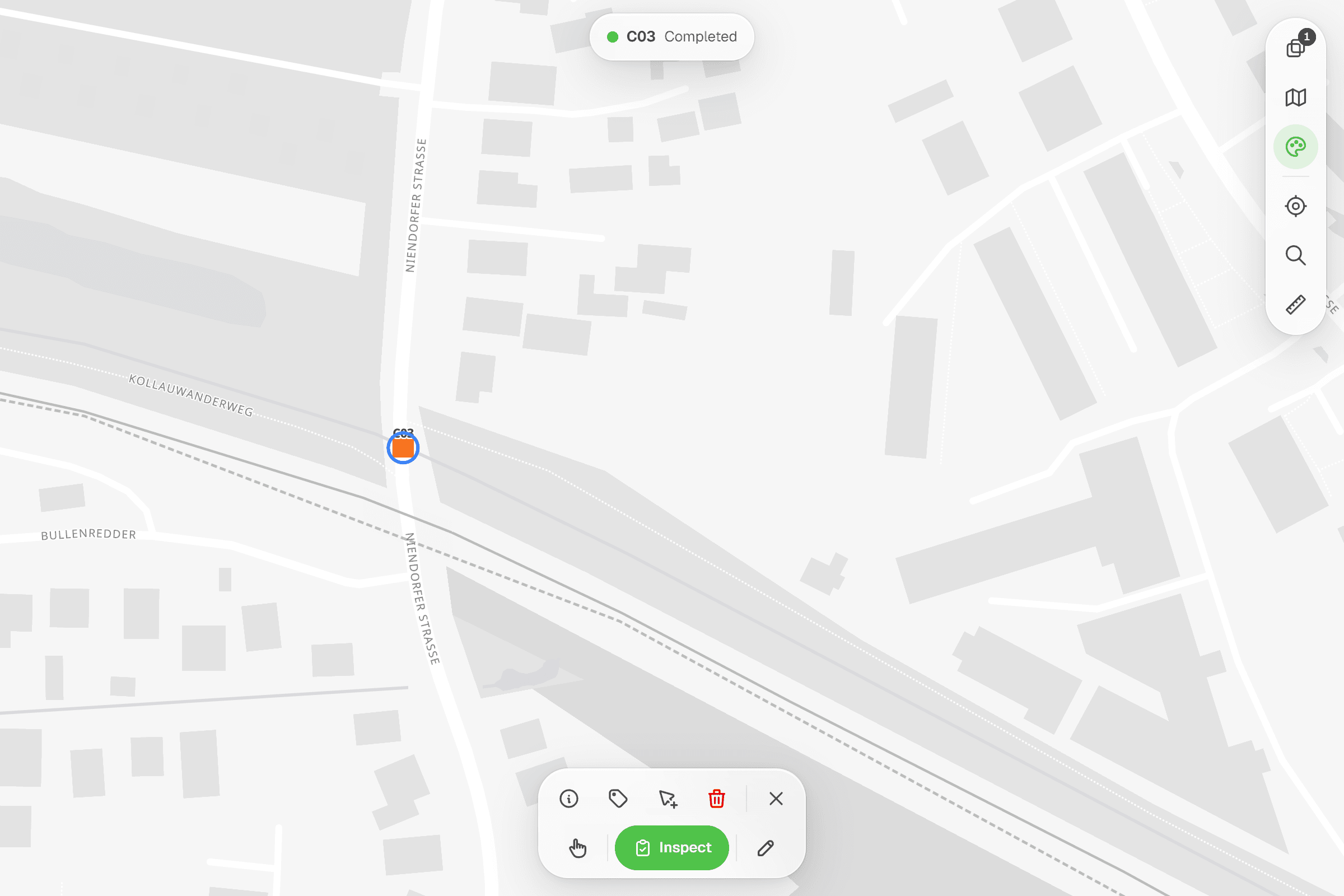
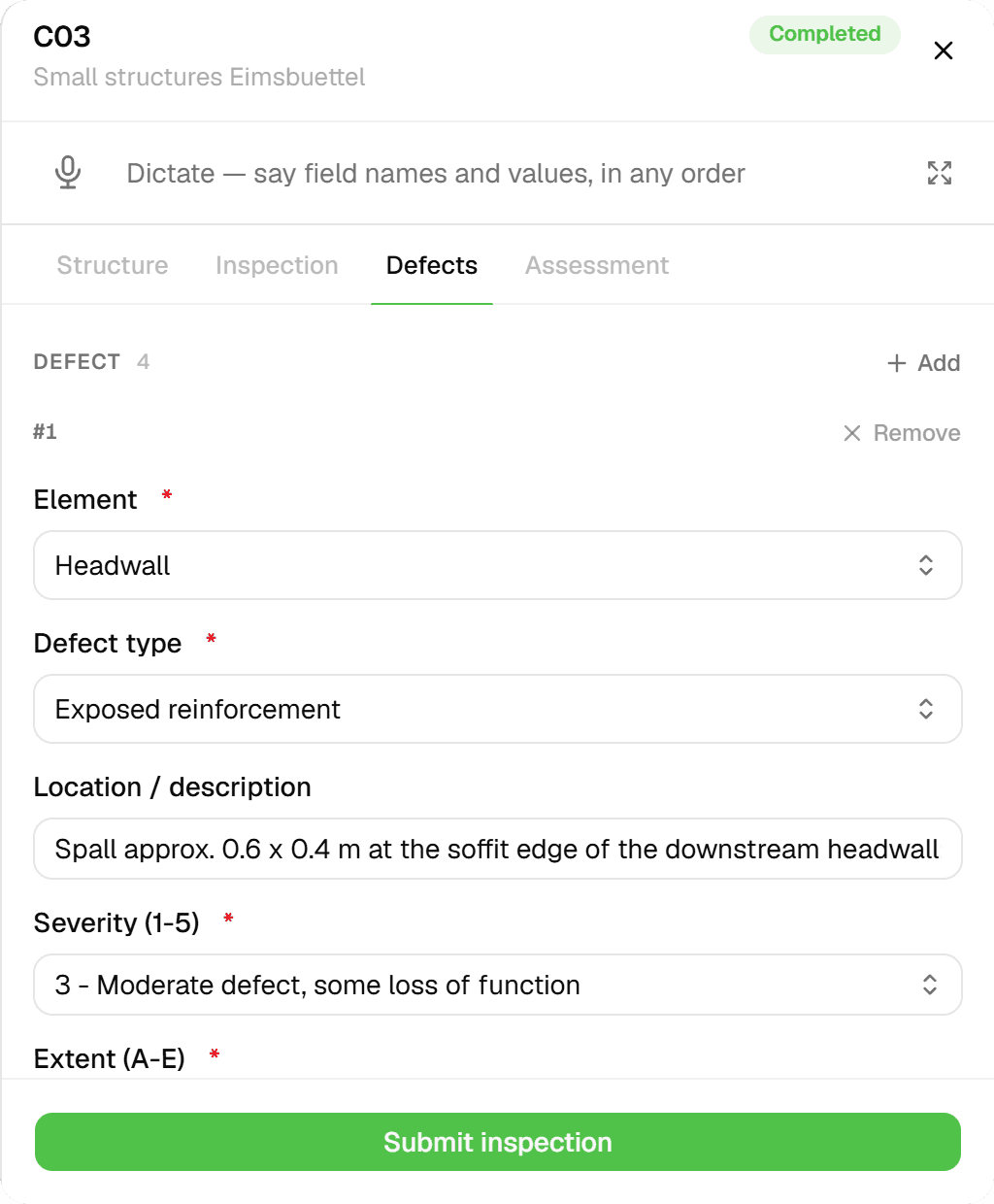
Structures are few and far apart, so the map is the inventory. In Geocadra you open a bridge or culvert where it stands, add each defect to its inspection form with photos, and read the last inspection in the history of the structure before you start the next.
Forms for the system you work in
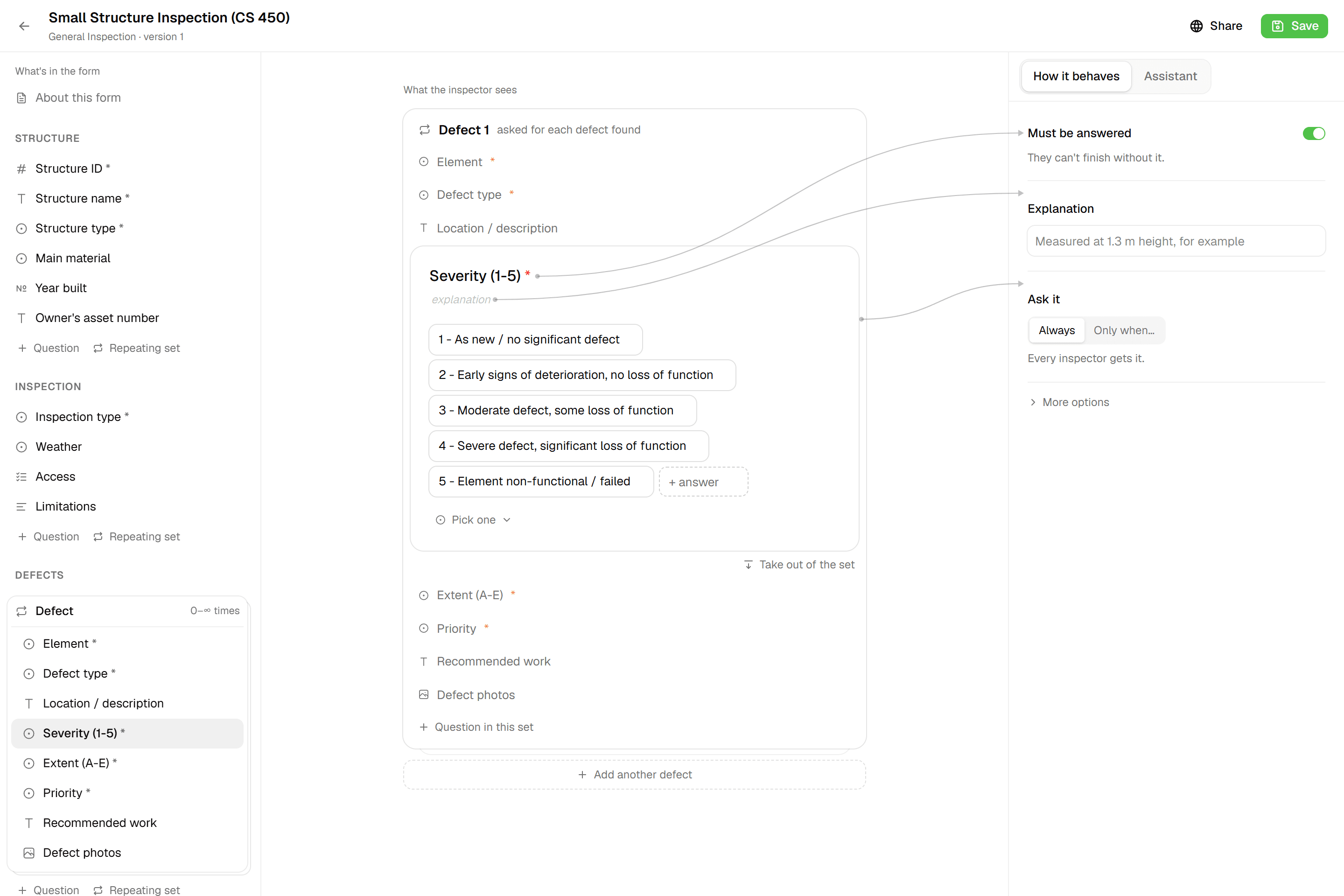
The form marketplace holds a small-structure form with severity and extent per defect, a form with the NBI component ratings and German forms for DIN 1076. Take the nearest one and change the element list to your structures.
The inventory first, also for what nobody listed
Import the inventory from a Shapefile, a GeoPackage, a CSV or the client's CAD drawing, and add the culverts nobody had listed straight on the map.
Defect by defect, element by element
Element, defect type, location, severity, extent, priority, recommended work and photos. Add as many as the structure has.
A report, and a file for the owner
A PDF inspection report drafted from the inspection data, and the same data as Excel, Shapefile or GeoPackage for the owner's asset system.

Questions about bridge inspections
How often does a bridge have to be inspected?
That depends on the system. Under the US National Bridge Inspection Standards a routine inspection is due at least every 24 months, more often for bridges in poor condition. The UK's CS 450 sets a General Inspection every two years and a Principal Inspection every six. Germany's DIN 1076 sets a main inspection every six years with a simple inspection in between, plus yearly visual inspections by the owner.
Does this checklist replace an inspection by an engineer?
No. It is a prompt for what to look at and a structure for the record. The inspections these systems require are carried out by qualified inspectors and engineers, and judging what a defect means for the structure is their work.
Can I download the checklist as a PDF or an Excel file?
Yes, both are free. The PDF is a sheet for one structure and one inspection, with columns for OK, defect and not applicable, a table for defects and a line to sign. The Excel file adds an inventory with one row per structure. Neither replaces the form of the system you report under: a bridge in the US national inventory is recorded on its state's form.
What about culverts and bridges under 20 feet?
In the United States a structure spanning 20 ft or less is not a bridge under the national standards and falls to its owner's own program. CS 450 covers spans greater than 0.9 m, DIN 1076, in its edition of 1999, bridges from 2 m. The checklist still applies; the interval is the owner's decision.
What is scour, and why is it on the list?
Scour is the removal of riverbed material around foundations by flowing water. It happens out of sight and fastest in floods. That is why the list asks you to probe at piers and abutments and to inspect again after high water.
Which rating scale should I use?
The one your client or regulator works with: component ratings from 0 to 9 in the United States, severity and extent under CS 450, the three criteria and the condition grade in Germany. If none applies to your structures, choose one and keep to it, because a rating is only useful next to last year's.
Can I fill in the form under a bridge with no signal?
An Android app that saves inspections on the device and sends them when it is back online is in early access; ask us for an invitation. The web app works wherever you have a connection.
More checklists and templates
Each page carries its document in full and links the standards it is drawn from.

Put your structures on the map
Import the inventory, pick a form and record the first inspection today. Free for 14 days, no credit card.
No credit card requiredFree trial included